The original article is here: Intel® Xeon® Processor Scalable Family Technical Overview.
This quick post is for the time challenged folks trying to figure things out as far as how the new Intel Xeon Processor Scalable Family relates to the previous generation Intel Xeon Processor E5-2600 series.
Please note that all of the images below are from the above article.

The above grid gives us an idea of which processor grade goes where. Our standard go-to has been the Intel Xeon Processor E5-2620 through the E5-2640 which were at one time the mainstream processors.
The next tier for us would be the E5-26*3 and E5-26*7 series that provided high bin counts (GHz) with low core counts.
Now we can see that the mainstream processors are Silver and the performance grade are Gold.

In the charge above 2S, 4S, 8S is the number of sockets the processor supports. DPC is DIMMs Per Channel.
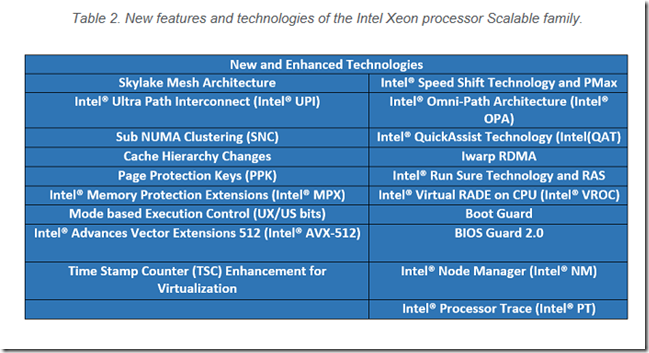
As we can see, there are just a few new features included in the new processor family.
Some Thoughts
There is a definite glaring omission in this new processor family: Fourth Generation PCIe :(
As we all know, the data bus is playing catch-up (blog post) to storage and to some extent networking.
While the newly introduced Purley platform has integrated PCIe NVMe ports on the server boards and backplanes there is still a lack of clarity as far as what we need to make things work on the Intel Server System platform.
The PCIe channel count bump from 32 to 48 is most certainly not enough especially with the spec stuck in Generation 3. A pair of 100Gb Mellanox Ethernet cards and a few PCIe NVMe SSDs and we're pretty much saturating the bus ... again.
And one more thing as we've not had a chance to compare apples to apples yet, the new processors look to be more expensive than the previous generation E5-2600v4 equivalents. And, it seems as the core counts go up so do the prices in an almost exponential way.
We'll post some price comparisons in another blog post.
Have a great weekend and thanks for reading!
Philip Elder
Microsoft High Availability MVP
MPECS Inc.
Co-Author: SBS 2008 Blueprint Book
Our Cloud Service


