Showing posts with label Banks. Show all posts

Thursday, 14 February 2013

Royal Bank of Canada Business VISA – Electronic Statements Available with Live Balances . . . Finally

One of our alternate financial institution’s credit cards has had online statements and live available credit balance for years.

It’s good to see that the Royal Bank of Canada has just enabled electronic statements for our business VISA card.

So, instead of having to run all 12 month’s worth of VISA statements through the ScanSnap 1400 to create PDF documents we can download them straight out of the bank’s online portal.

We are most certainly glad to see that the bank is catching up with the smaller institutions that have had these features for a few years now. :)

Now, to figure out how to stop all of the RBC statement/billing notifications that come to our e-mail address.

They should be off by default. Folks need to take a bit of initiative with online banking so that the Phishing folks don’t have a leg to stand on.

And one more thing, it’s a good idea to subscribe to a credit bureau’s quarterly credit report along with the ability to be notified any time a credit search hit has been done against one’s credit profile. It’s one of the ways we can protect ourselves against identity theft.

Philip Elder
MPECS Inc.
Microsoft Small Business Specialists
Co-Author: SBS 2008 Blueprint Book

Chef de partie in the SMBKitchen
Find out more at
www.thirdtier.net/enterprise-solutions-for-small-business/

Windows Live Writer

Thursday, 8 July 2010

Credit and Debit Card’s Chip And PIN Security?

We all pretty much know how things work when it comes to information, identity, and personal security.

The good guys are always playing catch-up with the bad guys.

The other side of that coin is that the bad guys do not take long to break into the good guy’s stuff.

A lot of companies are presenting the new Chip & PIN structures now commonly found in debit and credit cards as being secure.

But just like any door and key structure (remember this post?), the bad guys are really good at finding the weakest link in the security chain. The linked post was thieves finding the weakest link in the front door lock on our own office.

Most of the following Web pages in this post came via this Bing search:

Chip and PIN

So, let’s pick one such company and its Chip & PIN statement, a Canadian bank:

image

6. I've heard of Chip and PIN cards being compromised, is this true?

At this time, we are not aware of the chip being compromised on any Chip and PIN cards. Any compromised issues that have arisen have been due to the magnetic stripe that is also on the card. For the time being, all RBC Chip and PIN Visa cards must also include a magnetic stripe to ensure continued acceptance everywhere (including locations that have not converted to Chip and PIN technology). Without the magnetic stripe cards could not be used at non-chip-enabled terminals. Rest assured that transactions completed with the magnetic stripe on your RBC Chip and PIN Visa card are as safe and secure as ever. RBC maintains aggressive fraud prevention practices to reduce card fraud and to ensure cardholders are protected. In addition, the Visa Zero Liability policy protects you should your card ever be compromised due to fraudulent activity. For more information about this policy, see your cardholder agreement.

The link to the above FAQ as of this writing is: Royal Bank of Canada: Chip and PIN FAQs.

With statements like the above, a debit or credit card issuer may be inclined to deny any fraudulent claims thus possibly leaving the end user with large purchase(s) against their account.

End User Liability

Ultimately, the end user needs to provide some protection against the possibility of their Chip & PIN based debit and/or credit card being compromised. So, leaving the PIN on a sticky note or piece of paper in the same purse/wallet as the card is not a good idea.

Chip & PIN Compromised

One of the pages that came up in the Bing search was a World News Network article called Customers ‘blamed for card fraud’. That WNN landing page’s title actually carried a link to a BBC News article on BBC’s site.

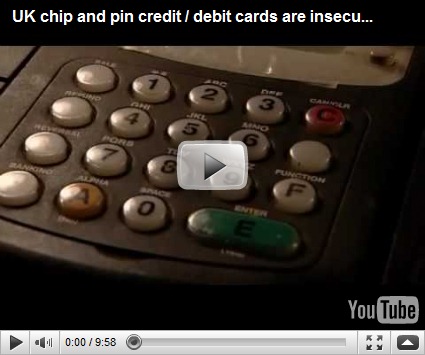
But, the World News Network site also had a link to a video demonstrating a Chip & PIN vulnerability. Be prepared to be shocked.

The above video is well worth watching from start to finish.

Fellow MVP Harry Johnston (Bing search) pointed to the following site in response to a question about Chip & PIN.

These are the folks responsible for the above video.

The blog post about the vulnerability published by the Cambridge group is here:

Note the link to a working draft of a research paper on this particular vulnerability is also to be found there.

The Need For Caution

The need to protect our personal identity and financial situation ultimately resides with us. Knowing what is out there in the way of threats to our financial or personal situation is a part of protecting them. Granted, we may never know all of the ways, but we can do our best to mitigate the risk.

So, logging in daily to keep an eye on our online banking reports, online credit card accounts, and other such services is important. We need to know if there are any fraudulent transactions as soon as possible so that we can address them with the bank or card issuer.

Also, paying attention to the folks running the payment terminals where we make our purchases and not allowing anyone to take the card out of our sight are two ways that can also help to mitigate the risk.

Philip Elder
MPECS Inc.
Microsoft Small Business Specialists
Co-Author: SBS 2008 Blueprint Book

*Our original iMac was stolen (previous blog post). We now have a new MacBook Pro courtesy of Vlad Mazek, owner of OWN.

Windows Live Writer

Tuesday, 23 March 2010

Windows 7 BSODs – RapportPG64.sys is the Culprit

To date, we have not encountered this product before:

image

The product is called Trusteer Rapport and looks to be installed by a bank . . . at least according to the product’s description.

Confirmation with the user is that the CIBC bank here in Canada (bank’s site) recommended that the product be installed.

The product’s site goes on to say:

image

Once installed, the Rapport application is virtually transparent and non-invasive.

However, since this product has been installed on a Windows 7 Ultimate x64 machine, it has caused no end of BSODs:

image

So, it is our recommendation that this product _not_ be installed, or if it is installed, to be aware of any system instability that has come about since that point.

No third party product eliminates the need for our users to be aware of the dangers and pitfalls of browsing the Internet on a machine where they have full admin rights . . . and how to mitigate that by having UAC on and their regular profile set up as a Standard User.

Philip Elder
MPECS Inc.
Microsoft Small Business Specialists
Co-Author: SBS 2008 Blueprint Book

*Our original iMac was stolen (previous blog post). We now have a new MacBook Pro courtesy of Vlad Mazek, owner of OWN.

Windows Live Writer

Thursday, 24 September 2009

Credit Card Agreement Changes – TWO On-Time Statement Periods Required Before Interest Free!

Okay, so we are guilty of not reading the new agreement that came out in the early spring from our credit card (CC) suppliers.

We have been so busy lately that a CC payment was missed by a couple of days.

So, when checking the transactions and balance on the card the interest debit was there and it was nowhere near the expected amount.

Apparently, if we took time to read the new agreement, the CC companies (that is VISA, MasterCard, and others) mandated that if an on-time payment was missed interest was calculated on all transactions, all transactions, from the beginning of the grace period to the date the interest debit was posted.

Now, if we make our next payment on-time, we will still have an interest payment appear on our next statement despite the fact that we paid off the balance. That interest will span the previous statement period and the current statement period as we understand the explanation.

Essentially, under the new terms our interest payment was what we were expecting plus 63% of the dollar amount due on the missed statement!

Lesson #1 learned: Read and try and understand the Terms & Conditions!

Lesson #2 learned: Pay off those credit cards on-time.

For high transaction volume cards like this one, that 63% represents a pretty steep step up for the CC company’s profit margins.

Looks like this is the methodology being used to recoup some of the new 1%, 2%, or higher “payback” type credit cards hitting the market as merchants have been very resistant to giving the CC companies and further slices of their pie.

In the end, there is no such thing as a free lunch. Someone has to pay for it and it always ends up being the end user/consumer.

Quote:

Interest

When you or your Authorized Users use your Visa Card or your Visa Account number to make a purchase, we are loaning you the amount of the purchase. You can avoid interest on both purchases and fees by always paying the New Balance in full on or before the Payment Due Date every month. Your New Balance is shown on your Visa Statement and is made up of all purchases, cash advances, interest and fees incurred up to the Visa Statement period end date.

If you do not pay your New Balance in full on or before the Payment Due Date shown on your Visa Statement, you will lose your interest-free status for purchases and fees. In such event, you must then pay interest on all purchases and fees shown on that month's Visa Statement as well as interest on all new purchases and new fees. Interest is calculated from the transaction date (for fees this is the date the fee is posted to the Visa Account) until the day we process your payment for the total amount you owe.

To regain interest-free status on your purchases and fees, you must pay your New Balance by the Payment Due Date. Interest on previously billed purchases and fees which has accrued since the end of the last Visa Statement period to the date payment in full of the New Balance is received, will appear on your next month's Visa Statement.

Philip Elder
MPECS Inc.
Microsoft Small Business Specialists
Co-Author: SBS 2008 Blueprint Book

*All Mac on SBS posts will not be written on a Mac until we replace our now missing iMac! (previous blog post)

Windows Live Writer

Friday, 29 June 2007

Banks ... Can't live with them ... Can't live without them?

We have a tightly regulated banking industry here in Canada.

We have several rather large banks, with the Royal Bank of Canada (RBC) topping out as number one.

I personally have been with the RBC for a long time. I opened my very first bank account with them, and presently will be closing my last.

Why?

Because they treat me like they are doing me a service for allowing me to bank with them. The focus of the business relationship is them and not me, their client, despite their ads saying the opposite.

They nickel and dime our business to death with their fees for everything.

They nickel and dime us to death with their fees for everything.

The banks seem to have forgotten that it was our money residing in accounts within their institution that enabled them to build their huge profit making machines.

So, now that their huge profit making machines are rolling, where exactly do those nickel and dime fees charged to us fall? Probably one one thousandth of a percent of their gross revenue. So, why exactly are we being charged banking fees again?

Client service my rear end! The client is number 1! Bullocks! :*Þ

No where have I been treated like I would treat my clients. This after close to 30 years with the bank!

As a result, we will be closing all of our accounts at the RBC and transferring them to an institution that is hungry for our business. This new institution has demonstrated to us recently that they may not have lost their perspective on who is number one: their client.

Philip Elder
MPECS Inc.
Microsoft Small Business Specialists