Showing posts with label Cost of Doing Business. Show all posts

Wednesday, 5 September 2018

When Software Bugs can Kill: Dodge RAM 1500 Cruise Control Bug

A while back there was a scary moment where the cruise control in our 2016 RAM 1500 refused to release via any of the buttons on the steering wheel.

In that moment, rushing up on a vehicle fairly far ahead of us and going over a bridge, there were only a few options left:

  1. Brakes release the cruise
  2. Try and Power Down & Brake
  3. Ditch @ 100KM/H on a bridge bank

Fortunately, the cruise released when the brakes got hit, we were able to avoid rear ending the person in front of us, and in fact the cruise system crashed right after the brakes were applied.

When addressing the complaint with Dodge and the dealer there's the, "Oh, no we didn't realize there was a problem there" type of response.

Well, obviously there was a problem that needed to be addressed as the bellow letter shows.

image

So, being that the problem could be life threatening we took the truck in to have it flashed as soon as the above showed up and the dealer had a spot open.

Here we are a few weeks or more from the day the flash was done and the behaviour happened again this morning. :S

Fortunately, at that moment there was less panic and more "Oh, hopefully the brakes work to kick it off this time" happening. ;)

A call into the dealer and the service tech indicated they'd have a conversation with the service manager since the tech was not sure whether there would be a "re-flash" of the module or the problem would need to head further up the Fiat Chrysler Canada food chain.

The Customer Service Wall

It's understandable that companies try and hide their mistakes. Yet, time and time again it's been shown that companies that are up-front about mistakes made and changes made to mitigate or eliminate them happening again tend to do quite well. It seems the lawyers tend to win this argument, and the ridiculous cases that have forced the issue, to keep things relatively hidden.

For the end-user it's very frustrating to face that "Customer Service Wall" with virtually no hope of getting anywhere beyond the person standing in front of that wall. In this case, it's the "Service Technician" that is in front of the Wall.

The reality is that the Customer Service Wall is a very well designed system to keep the person/user who is essentially paying the bills as far away from the manufacturer/vendor as is possible.

The same is true of voice recognition systems that users/customers hit as soon as they call "Customer Service".

There is no lack of irony in the above two sentences.

Conclusion

Sadly, the situation with the Dodge software bug, which can be deadly, will remain a mystery for a little while longer. With a bit of awareness, and a good dose of caution, we will be able to mitigate the bug's release block and not hit anyone including the ditch.

But for now, we wait until the folks that do the programming can figure out where the bug really lies and hopefully fix it … without introducing an even deadlier bug.

Philip Elder
Microsoft High Availability MVP
MPECS Inc.
Co-Author: SBS 2008 Blueprint Book
www.s2d.rocks !
Our Web Site
Our Cloud Service

Friday, 29 June 2018

Our Calgary Oil & Gas Show Booth & Slide Show

At the invitation of one of our suppliers, AVNET, I got to spend the day manning a spot in their booth.

image

Calgary International Oil & Gas Show 2018 AVNET Booth

Sitting on the table at the left is one of our Kepler-47 nodes and a series of storage devices one of which is a disassembled hard drive.

There were great conversations to be had with the folks at the other booths including Intel, Kingston, and Microsoft and their Azure IoT team among others.

Thanks to AVNET and the team. They were very gracious. :)

Here's the slideshow I put together for that monitor on the wall.

image

image

image

image

image

image

image

image

image

image

image

image

Just a note on the mentioned Intel OmniPath setup. In conversation with Intel post-slide creation it seems that OPA is not a Windows focused architecture so there's no opportunity for us to utilize it in our solutions.

To our Canuck readers have a great long weekend and to everyone else have a great weekend. :)

Thanks for reading!

Philip Elder
Microsoft High Availability MVP
MPECS Inc.
Co-Author: SBS 2008 Blueprint Book
Our Web Site
Our Cloud Service

Wednesday, 25 April 2018

Working with and around the Cloud Kool-Aid

The last year and a half have certainly had their challenges. I've been on a road of both discovery and of recovery after an accident in November of 2016 (blog post).

Most certainly one of the discoveries is the amount of tolerance for fluff, especially marketing fluff, has been greatly reduced. Time is precious, even more so when one's faculties can be limited by head injury. :S

Microsoft's Cloud Message

It was during one of the last feedback sessions at MVP Summit 2018 that a startling realization came about: There's still anger, and to some degree bitterness, towards Microsoft and the cloud messaging of the last ten to twelve years. My session at SMBNation 2012 had some glimpses into that anger and struggle about our business and its direction.

After the MVP Summit 2018 session, when discussing it with a Microsoft employee that I greatly respect, his response to my apology for the glimpse into my anger and bitterness was, "You have nothing to apologize for". That affirmation brought a lot home.

One realization is this: The messaging from Microsoft, and others, around Cloud has not changed. Not. One. Bit.

That messaging started out oh so many years ago as, "Your I.T. Pro Business is going to die. Get over it" to paraphrase Microsoft's message to change business models or else when BPOS was launched.

The messaging was "successful" to some degree as the number of I.T. Pro consultants and small businesses that hung up their guns during that first four to six year period was substantial.

And yet, it wasn't as much of the SMB focused Microsoft Partner network basically left Cloud sales off the table when dealing with their clients.

Today, the content of the message and to some degree the method of delivering the message may be somewhat masked but it is still the same: Cloud or die.

At this last MVP Summit yet another realization came when listening to a fellow MVP and some Blue Badges (Microsoft employees) discussing various things around Cloud and Windows. It had never occurred to me to consider that the pain we were feeling out on the street would also be had within Microsoft and to some degree other vendors adopting a Cloud service.

The recent internal shuffle in Microsoft really brought that home.

On-Premises, Hybrid, and/or Cloud

We have a lot of Open Value Agreements in place to license our client's on-premises solution sets.

Quite a few of them came up for renewal this spring. Our supplier Microsoft licensing contact, and the contractor (v-) that kept calling, were trying to push us into Cloud Solution Provider (CSP) for all of our client's licensing.

Much of what was said in those calls was:

  • Clients get so much more in features
  • Clients get access anywhere
  • Clients are so much more agile.
  • Blah, blah, blah
  • Fluff, fluff, fluff

The Cloud Kool-Aid was being poured out by the decalitre. ;)

So, our response was, "Let's about our Small Business Solution (SBS)" and it's great features and benefits and how our clients have full features both on-premises, via the Internet, or anything in-between. And, oh, it's location and device agnostic. We can also run it on-premises or in someone else's Cloud.

That usually led to some sort of stunned silence on the other end of the phone.

It's as if the on-premises story has somehow been forgotten or folks have developed selective amnesia around it.

What's neat though is that our on-premises highly available solutions are selling really well especially for folks that want cloud-like resilience for their own business.

That being said, there _is_ a place for Cloud.

As a rule, Cloud is a great way to extend on-premises resources for companies that experience severe business swings such as construction companies that have slowdowns due to winter. The on-premises solution set can run the business through the quieter months then things get scaled-up during summer in the Cloud. In this case the Cloud spend is equitable.

Business Principled Clarity

There are two very clear realities for today's I.T. Pro and SMB/SME I.T. Business:

  1. On-Premises is not going away
  2. Building a business around Cloud is possible but difficult

The on-premises story is not going to change. One can repeat the Cloud message over and over and to some degree it becomes "truth". That's an old adage. However, the realities on the ground remain ... despite the messaging.

Okay, so maybe in the smaller 10 or less seat business where an all-in for Cloud may make sense (make sure to add all of those bills up and be sitting when doing so!).

That being said, our smallest High Availability client is 15 seats with a disaggregate converged cluster. That was before our Storage Spaces Direct Kepler-47 was finalized as that solution starts at a third of the cost.

For the on-premises story there are two primary principles operating here:

  1. The client wants to own it
  2. The client wants full control over their data and its access

Cloud vendors are not obligated, and in many cases can't say anything, when law enforcement shows up to either snoop or even, in some cases, to remove the vendor's physical server systems.

Many businesses are very conscious of this fact. Plus, many governments have a deep reach into other countries as the newly minted, as of this writing, EU privacy laws seem to be demonstrating.

Now, as far as building a business around another's Cloud offerings there are two ways that we see that happening with some success:

  1. Know a Cloud Vendor's products through and through
  2. Build a MSP (Managed Service Provider) business supporting endpoints

The first seems to be really big right now. There's a lot of I.T. companies out there selling cloud with no idea of how to put it all together. The companies that do know how to put it all together are growing in leaps and bounds.

The MSP method is, and has been, a way to keep that monthly income going. But, don't count on it being there for too much longer as _all_ Cloud vendors are looking to kill the managed endpoint in some way.

Our Direction

So, where do we fit in all of this?

Well, our business strategy has been pretty straightforward:

  1. Keep developing and providing cloud-like services on-premises with cloud-like resilient solutions for our clients
  2. Hybrid our on-premises solutions with Cloud when the need is there
  3. Continue to help clients get the most out of their Cloud services
  4. Cultivate our partnerships with SMB/SME I.T. organizations needing HA Solutions

We have managed to re-work our business model over the last five to ten years and we've been quite successful at it. Though, it is still a work in progress and probably will remain so given the nature of our industry.

We're pretty sure we will remain successful at it as we continue to put a lot of thought and energy into building and keeping our clients and contractors happy.

Ultimately, that goal has not changed in all of the years we've been in business.

We small to medium I.T. shops have the edge over every other I.T. provider out there.

"How is that?", you might ask.

Well, we _know_ how to run a small to medium business and all of the good and bad that comes with it.

That translates into great products and services to our fellow SMB/SME business clients. It really is that easy.

The hard part is staying on top of all of the knowledge churn happening in our field today.

Conclusion

Finally, as far as the anger, and to some degree bitterness, goes: Time. It will take time before it is fully dealt with.

In the mean time ...

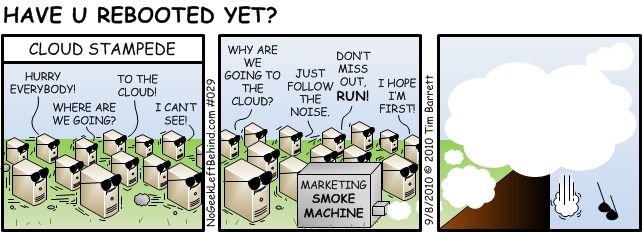
A friend of mine, Tim Barrett did this comic many years ago (image credit to NoGeekLeftBehind.com):

image

The comic definitely puts an image to the Cloud messaging and its results. :)

Let's continue to build our dreams doing what we love to do.

Have a fantastic day and thanks for reading!

Philip Elder
Microsoft High Availability MVP
MPECS Inc.
Co-Author: SBS 2008 Blueprint Book
Our Web Site
Our Cloud Service

Thursday, 11 February 2016

Philip’s Ultra-Healthy and Quick Technician’s Breakfast!

We’re all super busy. Eating breakfast is an important part of it with a home grown meal being way better than most anything a fast food place can serve. It’s a lot less expensive in the long run plus the time savings is huge!

This breakfast meal assumes the person is in some sort of regular excercise routine which is also an important part of keeping ourselves healthy. Right? ;)

  • Breakfast Sloppy Toast
    • (3) Large Eggs
    • ~125ml to ~200ml of Half & Half Cream
    • (2) Whole Grain, 12 Grain, or other such solid bread
    • 1/8” slices of Cheddar, Marble, Havarti, Mozza, or other favourite cheese
    • A good chunk of baby spinach
    • A proper Pyrex microwave dish and cover
      • Plastic containers melt into the food :P
      • Ours is just larger WxL wise than the bread slizes and tall enough to host the lot

With the above:

  1. Break the 3 eggs into the Pyrex dish
  2. Start whisking
  3. Add cream until well frothed
  4. Place first slize of bread in the mix
  5. Cover the bread with the cheese slices
  6. Drop spinach in and evenly distribute
  7. Place second slice of bread in
  8. Use a spat to flip the stack over
  9. Press in to allow mix to soak into the new slice
  10. Cover and microwave for 5:15 at 60%
    1. Let sit for about a minute after the cycle completes
  11. Microwave for about 1:45 to 2:45 at 60% depending on microwave power

Once it’s done let it cool off for a good five minutes.

Total time put in to the above: Less than 4 minutes.

Time savings over the week?

Assuming a minimum 15-20 minute wait at Timmys (Tim Hortons) that’s easily 15 minutes per day or more.

Cost savings?

Two breakfast egg sandwiches with cheese and bacon on an English muffin is $6.20. The savings can be quite substantial.

I usually have a couple of Vietnamese bird peppers to chow on while eating the above to accentuate the flavour. ;)

While this breakfast is not for everyone, it follows a 50/25/25 rule for protien/fat/carbs. Tie that in to a good regular cardio workout we’re good to go!

Thanks for reading. :)

Philip Elder
Microsoft High Availability MVP
MPECS Inc.
Co-Author: SBS 2008 Blueprint Book

Tuesday, 26 January 2016

Opinion: Yammer Needs To Go

With all due respect, Microsoft really needs to cut and run from Yammer.

We bill into the hundreds of dollars per hour.

Yammer is such a bleed on time that it is costing us substantially to try and get any kind of use out of it.

We’ve all but abandoned the platform for all but necessary tasks.

We already wasted a couple of hours this week trying to get to our content downloads for our business needs.

We can’t imagine the impact to Microsoft employee productivity that Yammer has had. But, given our experience it has to be substantial.

Yammer needs to go. In our not so humble opinion it’s worse than a 1988 Yugo and it’s 3-6 month air cooled engine life.

image

Image Credit: Bing Search

Microsoft trying to fix it is no different than trying to fix a Yugo. In our opinion it’s good money after bad.

[/RANT]

Philip Elder
Microsoft High Availability MVP
MPECS Inc.
Co-Author: SBS 2008 Blueprint Book

Friday, 13 November 2015

Some I.T. Professional Business Pearls

Here are some thoughts on the many aspects of running an I.T. business in today’s world that have been garnered over my 13 years in business so far.

  • Never reveal business operations
    • Financial
    • Client’s names (don’t ever reveal clients supported to others)
    • Projects, Purchases, or other such products and services WE provide
  • Never volunteer _any_ information
  • Always keep scheduling information time related
    • I’m running behind, I’ll call in 15
    • I’m working on something that went sideways, let’s delay to tomorrow please
    • Always call, text, reach out in-person versus e-mail
      • If calling follow-up with an e-mail “thanks for allowing us to delay by a day” or some such note
    • We keep a priority band that our clients are aware of
      • Priority 1: Business Critical Outage
      • Priority 2: User down or problematic app
      • Priority 3: App updates, changes and such
      • Priority 4: All of the other stuff
  • Never, ever, give a customer poop for leaving
    • I learned this one the hard way
    • Business is business no matter how the termination was handled by the now former client
      • Never, ever, take things personally
    • Respect their decision and acquiesce with grace and integrity
    • Be silent
    • Resist the urge to be defensive - shut this one right down
    • Cooperate with the next I.T. company if need be
      • Give over the keys to the kingdom with ease
  • Always, and everywhere, do everything in writing
    • “Yes, Ms. Customer, I’d be more than happy to help you do X and it’ll be done on Y” via e-mail after a conversation
    • Always confirm project add-ons and scope creep with an e-mail indicating back charges and extras as they fall out of scope
    • Keep an extensive set of audit notes for each client
    • Keep an extensive change log for all clients
    • image Snip everything, name them accordingly, and keep them forever
    • Be disciplined and document everything
  • Use a time keeper
    • Outlook Tasks or CRM with due dates and reminders
    • OneNote notebook with Surface 4/Pro and pen close at hand
    • Note keeper pocket notebook and mechanical pencils
    • Write all requests down and transfer what needs to be to Outlook or CRM

The above is the culmination of my 13 years running our I.T. company. I hope it helps! :)

Philip Elder
Microsoft Cluster MVP
MPECS Inc.
Co-Author: SBS 2008 Blueprint Book

Tuesday, 27 January 2015

Business Guidance Pearls Mentoring Opportunity

Our blog post on Some IT Pro Business Guidance Pearls has generated a _lot_ of questions! Thank you for that. :)

So, how about this?

Third Tier has a special on a block of 3 hours that ends in a few days.

Drop in to the Third Tier Help Desk, register, and purchase a time block. From there, open a ticket: Business Guidance Pearls Mentorship.

I would pick up the ticket and get in touch about scheduling our time together.

The structure would be:

  • 1 Hour: Practice Assessment and Goals
  • 1 Hour: Goals Roadmap
  • 1 Hour: Goals Implementation Steps

I was very fortunate to have a former employer that worked very hard to teach me how to run an I.T. business. By “run” we’re talking about a lot more than just the bookkeeping and cash flow aspects.

Believe me when I say this, you’d not regret any minute spent. We’d look at the big picture right through to the details to facilitate growth in your I.T. Pro practice.

Philip Elder
Microsoft Cluster MVP
MPECS Inc.
Co-Author: SBS 2008 Blueprint Book

Chef de partie in the SMBKitchen ASP Project
Find out more at
Third Tier: Enterprise Solutions for Small Business

Thursday, 8 May 2014

SMB Kitchen ASP Project: Content Posted

I've posted a number of items to the ASP Project Knowledgebase.

Client Quote Template

image

This four sheet quote template allows us to create a quote for a server, desktop, storage, laptop, or other system based on expected pricing, current pricing, and then actual pricing to give us full control over our margins and expected sell prices.

The first sheet is where we work. The others are used to present the prospect or client a fully detailed list with price or just a fully detailed list for pasting into a proposal. The Build Sheet is part numbers, distribution source, pricing, and Order/Receive status.

All calculations are handled by this spreadsheet including leasing using the numbers our brokers supply us.

Client Audit Notes Template

In the Documentation link you will find our audit notes template:

image

image

In it you will find what we have built up for the last decade or more to manage our client's very diverse network infrastructures.

Client E-mail Templates

Finally there are three information templates that we use to e-mail our clients once in a while depending on the circumstances.

image

If you have not already done so please sign up. There is a lot more to come in the way of content produced by Amy, Susan, and myself for the SMB Kitchen ASP Project.

Philip Elder
Microsoft Cluster MVP
MPECS Inc.
Co-Author: SBS 2008 Blueprint Book

Chef de partie in the SMBKitchen ASP Project
Find out more at
Third Tier: Enterprise Solutions for Small Business

Thursday, 3 October 2013

Attitude and Gratitude

To date I don’t believe I’ve ever crossed the line into political commentary.

No, this is not about what is happening South of the border (being in Canada that).

This is about our own little world here in St. Albert. We have been supporting the St. Albert Youth & Community Centre for quite a few years now.

In fact, we did what we could for them in the way of time and product as the service they provided to the youth of St. Albert touched very close to home for me.

Attitude

The attitude is in how we take full and complete responsibility for what we do in our business, in our community, and within our own personal lives.

This attitude seems to be a direct antithesis to the prevalent “blame anyone but me” we see in the news, politics, and unfortunately in business.

We seem to live in an era where the word “responsibility” is a four letter one.

The local St. Albert administration pulled a significant chunk of the Youth Centre’s (YC) funding last year. So, when the YC got into a bit of a spat with the landlord over who should fix the very leaky roof (not drips but _gallons_ the standoff ended with the YC needing a new home.

When the City Council pulled funding last year the YC decided to keep in trying to serve the Youth of St. Albert. They worked very hard to build funding from other sources to replace the well over $110K they lost from the City.

Unfortunately, due to the pulled funds when the row with the landlord came to a finish the YC did not have sufficient funds in place to find a new location.

The City Council’s and Mayor’s spin on the loss of the YC was sad to see. At no point did this council or mayor take responsibility for the fact that they pulled the funding needed for the YC to survive in a new location. It was the landlord’s fault that the YC needed to close.

We picked up the last of their equipment this Monday as they closed up shop. It was a sad day for the both of us but most especially for the youth that no longer have a safe place to go.

And, it was a first-hand experience of how folks in politics can seemingly spin anything to defer responsibility for something they were a party to. This truly saddens me as well.

Gratitude

And finally, when we receive a referral either from a client or fellow IT Provider we make a point of offering some form of thanks.

Gratitude, that is being thankful for the business referred to us is a very important thing. Folks did not have to reach out to us in the first place or could have gone somewhere else with the business.

Thus, when we reach out and bring another IT firm, or specialized service firm, or whatever they may be doing into the mix one would expect at least a “Thank you” or even a small finder’s fee to toss in the company coffee fund.

When that does not happen then what are we to think?

Suffice it to say we would probably be taking those kinds of needs to another company a lot more willing to “partner” in the true meaning of the word.

Author’s node: Yeah, it’s been a bit of a tough week.

Thanks for reading. Our clients and you make things all the more worth it to keep plugging along. :)

Philip Elder
MPECS Inc.
Microsoft Small Business Specialists
Co-Author: SBS 2008 Blueprint Book

Chef de partie in the SMBKitchen
Find out more at
www.thirdtier.net/enterprise-solutions-for-small-business/

Windows Live Writer

Wednesday, 28 August 2013

Some Thoughts on Microsoft in the SMB Space

If one approaches this post from an emotional level, that is built on all of the angst, struggles, and pain born of the Cloud drums out of Microsoft, that is their message but also the many products and services cancellations, over these last three or so years then it would not be hard to go down a very not-so-happy path.

So many bridges between Microsoft and us IT Solution Providers that work on the front lines of the SMB IT space (by our definition SMB is 1-75 seats or so) have been burned or even out-right blown up.

Many of us have struggled with the angst over where we were going to take our business and what kind of business model we would have two, five, and even ten years down the road. After all, we are in it for the long-haul right?

Why We Do IT

This post is more a reflection of the SMB IT Provider that is in the business out of passion for the products and services we get to work with. But, most especially for the joy it brings us to have a set of very happy clients on the other end of our IT practices.

That is our greatest reward. That is clients whose businesses are in the business to make money and do so as efficiently as possible on their IT because of what we do for them.

For us, the reality has come home to roost that Microsoft is much less a partner today than a competitor.

Yes, we are still building our solutions on the Microsoft stack and will continue to do so. Our solutions absolutely rock utilizing the products we do. We will continue building solutions that our competitors, like Microsoft and other large IT Solutions providers, could hardly hope to develop for their clients.

Why?

Because we as small business IT Solutions Providers live, breath, and work in the SMB Trenches. We understand small business in a way that a Gartner Survey or any other such knowledge peddlers could never hope to. This is because we _are_ a small business.

We small businesses are _not_ consumers, pro-sumers, or any other such "consumer" of goods and services.

We _produce_ products and services for others to consume. Or, we develop and sell products and services for other businesses to utilize in their _production_ of goods and services (Business to Business).

Microsoft's Value in SMB

So, what value do we see in Microsoft in today's SMB IT marketplace?

  • Products/Features
    • Hyper-V
      • Virtualization solutions have become affordable, both on VMware and Hyper-V, as a result of the competition between the two.
        • All one needs to do is watch VMware's stock and current restructuring efforts to see the impact Hyper-V has had on their margins.
      • Stack builds on a single box save our clients a lot on hardware, power consumption, cooling, and noise.
      • Clusters are very affordable for our clients when truly commodity based hardware (Intel Server Systems) are utilized over Tier 1.
    • Windows Server Essentials Experience Role
      • Finally, the Remote Web Access portal, RD Gateway, and other SBS-Like goodies can be dropped into a Windows Server Standard server setup.
    • Storage Spaces
      • Still new, but with lots of potential to impact how we do things for our clients with larger data sets.
    • Exchange
      • Despite the poor start to the product at what was probably Early Preview bits branded as RTM, Exchange Server 2013 is an awesome product with great potential for on-premises mail and BYOD management.
  • Partner Program
    • Loss of the Small Business Specialist program.
      • This is probably the "nail in the coffin" as far as the Cloud message to SMB IT Providers.
    • Competency Program structures drive us to expand or further distance ourselves from the Partner Program
      • Some of us are not comfortable with the idea of hiring on.
      • Plus, there are any number of other reasons for us to remain where we are at for now.
      • There are opportunities though. We just need the vision, time, and energy to pick them out and develop them.
    • Cloud, Cloud, Cloud, Cloud (Monty Python-esque theme here :) )
      • The drums are still beating.
      • The message is becoming all the clearer: Folks in SMB do not require any outside IT help. You can do it all yourself!
    • Cloud Essentials Program
      • Better get on board and start playing around with the freebie credit for Azure as this is one spot where we can develop some business opportunities.
  • TechNet
    • Now, keep in mind that folks that are Open Licensed will continue on with their TechNet subscriptions that are a Software Assurance benefit.
    • The loss of TechNet for lab use is most certainly of concern, but one has to wonder why it was terminated.
      • IMNSHO, we are at a point where the passionate SMB IT Provider, and Microsoft, have received yet another black eye due to the unscrupulous folks that abuse the system.

We are of the opinion that the current wave of Microsoft products, with the exception of Office 2013, are probably some of the best that we've seen in years.

Yes, mousers cried foul over the loss of the Start Button in Windows 8. But keyboarders never missed it. :) And yeah, there is a bit of a training struggle for folks to understand that there are two "rooms" if you will in Windows 8.

Microsoft "Partner"

With all of the changes that we've seen in Microsoft over these last two to three years we really have to wonder where they are going to be in two, three, or even five years.

Sadly the reality that the desktop PC is not really going to disappear in a business setting does not seem to phase anyone in stratosphere management at large corporations like Microsoft. :(

To top it all off, IMNSHO, the server is _not_ going to disappear in the SMB space.  Nor will the need for on-premises mail.

However, with the advent of so many failed/bad Microsoft product updates lately on so many products, some bringing down Hyper-V Failover Clusters, one really has to wonder how far off the vision has gone from providing a rock solid on-premises product experience from RTM to retirement?

Hopefully the bad patching situation that has been happening lately is only temporary and Microsoft moves some development back into actually testing those updates before deploying them to the world.

After all, being in business is about the products and services right? It's about providing the best possible value to the end-customer/client isn't it?

Can folks _really trust_ a company to provide a great Cloud experience when it seems like the on-premises products and services may be on their death-beds? Why develop patches and _test_ them if there is no will to keep the on-premises products alive?

And that begs this question: Can we SMB IT Solution Providers trust a company that has not come right out and said it, but has essentially drummed the message all the more clearly in these last 12-18 months that the "end is nigh" for the SMB IT Solution Provider? SMB belongs in the Cloud after all. Right?

Be straight with us. Be clear with us. If we knew where we truly stood as a "Partner" of Microsoft we would be better able to make decisions about where we are and where we need to go in the new era of competition _with_ Microsoft.

Trust is based on honesty between the parties. The messages out of Microsoft have been so mixed, and sometimes outright confusing, these last few years that one is never sure where we stand anymore.

Most certainly we need to be very aware, and wary, of what is happening both within the companies that produce the products we utilize and then within the product groups themselves.

Business Opportunities

On the flip-side the current state of SMB IT can provide an awesome opportunity for us to advance our on-premises and hybrid solution sets and skillsets. While it may seem daunting at first, we can indeed continue to build our SMB IT practice and triumph despite the naysayer's constant messages!

And, perhaps in the midst of all of this we could end up growing our businesses into that Microsoft Partner Competency holder that would get noticed and direct Partner support (note the absence of the quotes).

In the end, we may not reach those competency levels and/or even get noticed.

But, we can go home at the end of the day, maybe work a bit in the evening for our clients, knowing full well that there is a great group of folks, our clients, on the receiving end of our products and services that are very happy with us and what we do.

And that my friends is why, for the most part, we can sleep well at night eh? ;)

Well, maybe most nights. We are, after all, small business owners so the occasional sleepless night is a prerequisite! :D

Thanks for reading.

Philip Elder
MPECS Inc.
Microsoft Small Business Specialists
Co-Author: SBS 2008 Blueprint Book

Chef de partie in the SMBKitchen
Find out more at
www.thirdtier.net/enterprise-solutions-for-small-business/

Windows Live Writer

Tuesday, 27 August 2013

Our Value to Our Clients is in Our Knowledge and Experience

(Posted to the SBS2K Yahoo Group)

When we look at SBS 2003 and the growth in product and features over its lifespan we have an idea of how the single box will perform.

SBS 2008 and Exchange 2007 we encountered an exponential growth in the need for disk I/O due to Exchange and RAM due to both Windows Server (Vista code) and Exchange.

Move to SBS 2010 and Exchange 2010 and if we were keeping an eye on the various product groups and their direction for the product we would have seen _before_ SBS 2011 STD ever RTMd that Exchange 2010 was designed to run on one SATA hard disk with everything in RAM. We would have then planned our deployments, both physical and then virtual as that became much more common, around the server products built-in.

The key to any single host design or cluster design is in what will be running on top of them. Obviously, but maybe not?

Here, our experience comes into play if we have been taking the SBS product and tearing it apart for the last ten years and three major product iterations. The inner-workings of SBS, Exchange, Active Directory, Group Policy, SharePoint, and so many other server feature sets were there for us to explore. Not only that, Microsoft gave us a really solid template to carry forward into our now stacked solution sets.

  • VM0: AD, DNS, DHCP
  • VM1: Exchange or LoB
  • VM2: SQL or LoB
  • VM3: RDS

Provisioning the above has not changed in a sense. We need to augment our host configuration for the extra 15GB of OS space per VM perhaps. But, for the most part our physical hardware will be similar in nature to what we would deploy for previous versions of SBS Standard _given the products running in the suite_.

The key in all of this is knowing how the various server products will behave given certain workloads.

SQL has an I/O tester. Exchange has a load tester called Jetstress. Those two utilities can help us understand what our small, medium, and large clients can expect for a given server topology. They can also help us to deliver a solution tailored to their specific needs.

Having a lab is key to getting to know the products and how to put them together.

Testing _every_ solution that goes out the door before actually setting up the client’s own solution set is also critical.

Knowledge is key to our value to our clients. Lose that and we’ve pretty much lost the game.

It takes lots of time. It can take a lot of money. But, in the end training and grinding away at configurations in a lab is key to our client’s success and to ours as well.

Philip Elder
MPECS Inc.
Microsoft Small Business Specialists
Co-Author: SBS 2008 Blueprint Book

Chef de partie in the SMBKitchen
Find out more at
www.thirdtier.net/enterprise-solutions-for-small-business/

Windows Live Writer

Friday, 2 August 2013

A Really Good Read on the State of IT and Cloud Outsourcing

It seems that Aidan Finn and I are somewhat on the same page as far as how the Cloud has been significantly strong due to the “Bad IT Pro”.

Indeed, if we in the SMB community especially had a majority of IT Pros that fit into the “Good IT Pro” category as defined by Aidan the Cloud would probably have little place in the small to medium business.

Now, have a listen to my interview podcast with Robert Crane of CIAOPS in Australia that was done in December of 2012:

Robert and I have a pretty good parlay around the Cloud versus on-premises situation in SMB IT with my touching on the need to be trained, keep up on the tech, and work hard at IT!

Ultimately, it is our responsibility to make sure our skill-set is up to the task of providing the best IT Solutions for our clients. This task costs in both time and money with the investment, yes it _is_ an investment to get trained, paying off in ways we sometimes are not able to anticipate!

Philip Elder
MPECS Inc.
Microsoft Small Business Specialists
Co-Author: SBS 2008 Blueprint Book

Chef de partie in the SMBKitchen
Find out more at
www.thirdtier.net/enterprise-solutions-for-small-business/

Windows Live Writer

Monday, 8 July 2013

Things are Cloudy: Some Monday Morning Cloud Reading and Thoughts on Trust

Here are a few interesting articles that paint some reality on the ongoing Cloud picture.

Both articles are a good read and provide some insight into company’s perspectives on being in the Cloud and Microsoft’s vision for the Cloud.

BTW, what exactly is meant by an “update” anyway? We are not too sure on that one.

Conflicting Messages for SMB IT

Now, the kicker that really brings about the meaning of the word “irony” is in this quote from the Business Week article.

The Office unit says packaged releases will still be available to users who are resistant to Office 365 and its frequent updates, but most of the team’s energy will be focused online. “Microsoft has an established history and trust with customers [emphasis ours],” says Pisoni. “So far those who are hesitant about going to the cloud, they’re willing to put their trust in Microsoft. No other competitor—Google, Box—has that established trust.” Raman Padmanabhan, chief information officer for Xerox’s (XRX) business services unit, has been briefed on Microsoft’s move to faster updates and says he supports the shift as long as the product is good. “It’s all about service and quality,” he says. “You have to have a certain quality or it just kills your business.”

How many of us in SMB have been banging our heads against the wall, so to speak, trying to make the message clear that in SMB IT it is the face-to-face time and relationship trust that we build up with our clients that are keys to both business’s success?

The business relationship and trust have always been, and will always be, the foundation to our way of doing business.

The Cloud Message and many of the Cloud Prophets have been trying to blow that off for SMB IT for the last three or four years now and yet here we have it straight from Microsoft. _Trust_ is the foundation for moving forward.

Yes, there is a little bit of frustration here and it may show so our apologies for that. :S

But, at least it is good to see in print that our own SMB IT way of doing things is confirmed, though not directly. :)

As time goes on we shall see how all things play out.

From this arm chair it looks like Microsoft is in the process of slaughtering their cash cows and diving in for the lowest common denominator ... which in the end means that they will be on the same, and level, playing field as the other Cloud Vendors.

IMNSHO, this is _not_ a good place for Microsoft to go.

Most especially because a huge chunk of the Microsoft Partner base, that is those of us IT Providers in SMB, is being stepped on to get to wherever Microsoft’s current Cloudy Vision is leading them.

Philip Elder
MPECS Inc.
Microsoft Small Business Specialists
Co-Author: SBS 2008 Blueprint Book

Chef de partie in the SMBKitchen
Find out more at
www.thirdtier.net/enterprise-solutions-for-small-business/

Windows Live Writer

Tuesday, 21 May 2013

Repeat After Me: DHCP and DNS Belong on a DC

When configuring any network one needs to have an understanding of just how DNS works.

If DNS is not set up correctly there are so many things that break it is not funny.

Unlike mail routing (MX records) that offer a priority system for directing mail to the final destination where the system compensates for an offline mail server DNS operates in a round robin fashion.

So, if DHCP is set up on a router and delivers the following IPs for the client’s DNS queries:

  • 192.168.99.5 (local DC)
  • 192.168.99.1 (router)
  • 8.8.8.8 (Google DNS server)

Guess how many times the client’s on-premises resource DNS queries, in general, will fail.

If you guessed “67%” then you would be right.

It seems that folks are missing the reason for “Domain” in “Domain Naming System” or DNS for short.

The primary excuse we’ve heard so far to set the above DNS server IP settings on clients and even Remote Desktop Services servers and other servers is:

  • I want my clients to be able to browse the Internet if the DC and DNS goes offline.

There is, however, a fatal flaw in that line of reason . . . the missing “Domain” in DNS.

Or, to be blunt: A lack of understanding how DNS works on-premises and on the Internet and why the two are separate from each other.

Let’s have a look at this very crude drawing:

image

The left hand box is the on-premises Domain network. On that network MYDC is authoritative for that domain. Everything inside the box boundary for the network belongs to that DC and its on-premises DNS setup.

MYDC is the Start of Authority (SOA) for that domain (DOMAIN.LOCAL).

Being that our MYDC has the SOA means that no other DNS server _anywhere on the planet_ will be an authority for that domain. At least, for _that_ particular domain name in that particular location.

Not to mention the Top Level Domain (TLD) .LOCAL is not to be found anywhere on the Internet either.

What that means is that any client that queries DNS where MYSQL is will get the correct IP address from the DC that hosts the on-premises _domain’s_ DNS because that server is _authoritative_ for that domain.

Now, what happens on the client if they query DNS for MYSQL.DOMAIN.LOCAL and Google/OpenDNS server IPs are on the client’s DNS “where to query” server list and they respond?

That query goes OUTSIDE of the domain network to Google or OpenDNS and the response back is, “I have no clue who, what, or where the chicken DOMAIN.LOCAL is. Check ROOT SERVERS.” And of course, they answer same.

So, we have 67% of our on-premises queries failing DNS resolution.

Let’s think about that for a moment.

. . .

67% of our DNS queries are FAILING.

That means poor network performance, network print problems, LoBs that depend on database/SQL connections losing their connections, improper RDP routing, and so much more.

The _proper_ way to configure a domain’s DNS is as follows:

  • On the only DC on the network
    • AD and DNS are properly integrated
    • DHCP on the server
      • Name Protection Set (Ticks on 2003):
      • image
      • Admin credentials set to update DNS with IP:image
  • The DC NIC properties:
    • IP: 192.168.33.5
    • SN: 255.255.255.0
    • GW: 192.168.33.1
    • DNS0: 192.168.33.5 (SELF ONLY)
      • AD integrated DNS takes care of delivering IPs for other DC with DNS on the network. There is NO reason to put any other IP in DNS1.
  • DHCP configuration:
    • Scope Options:
      • 003 Router: 192.168.33.1
      • 006 DNS Servers: 192.168.33.5 (and other AD integrated DC/DNS server IPs)
      • 015 DNS Domain Name: DOMAIN.LOCAL
    • That’s it. Google/OpenDNS server IPs DO NOT belong here.
  • DNS Server service
    • Forwarders Tab
      • OpenDNS IPs or ISP’s DNS server IPs (at least two).

DHCP belongs on the server. Period. Full-stop.

If DHCP is on the router with DNS pointers to Google/OpenDNS or ISP DNS servers served to the on-premises DHCP clients then changes need to be made to put DHCP back where it belongs. . . on the DC.

If there is a concern about the only DC going down and leaving the clients helpless then make sure the backups are good.

If a need for redundancy is there then install an HP MicroServer with a Standard license and DCPromo that box into the domain. Make sure replication and AD integrated DNS are functioning between the now two DCs on the domain (we’ve seen situations where the second DC or RODC had no SYSVOL due to broken replication).

Or install an online cold backup device but make sure that the primary server has Software Assurance as Cold Backup is an SA only option.

For Small Business Server networks there _is_ a caveat to having another DC on the domain when in a disaster recovery situation.

In the end, a good chunk of the problems on a network such as connectivity, Line of Business application problems, performance, and more can have their source in an improperly configured DNS structure.

It is our job as IT “Professionals” to know the “WHY” things work so that we can set things up properly.

Philip Elder
MPECS Inc.
Microsoft Small Business Specialists
Co-Author: SBS 2008 Blueprint Book

Chef de partie in the SMBKitchen
Find out more at
www.thirdtier.net/enterprise-solutions-for-small-business/

Windows Live Writer

Tuesday, 7 May 2013

The “Right” Client and Our Business

Fellow MVP Cris Hanna pointed to the following article:

It took us almost 5 years to be able to start being choosy about the work we took on and the client relationships we wanted to build.

In that first five years we had to learn _a lot_ of lessons from the school of hard knocks.

Everything from a long standing and ongoing client not paying for work they signed off on to folks that expected a whole lot of work for no pay.

Then there was the scope creep on big projects where the original job, say a migration, then included a bunch of Line of Business application upgrades and migrations . . . and were not in the original proposal/agreement but, “since you’re already here . . . “

One of the more difficult lessons was in communication. That is communicating with the client about ongoing scheduling, jobs, and other task needs.

A really bad habit to break is to _not_ communicate with a client we have an appointment with that we are running late or even that we may need to reschedule.

In this day and age where we are facing pressures from all sides to cut and run we need to be extra mindful of the one gem in the rough we have in SMB: The face-to-face contact and relationship with our client contacts.

  • Be a man, or woman, of our word.
    • Need to make a change? Communicate first.
  • Use the tools at hand.
    • Outlook calendar invites, ticketing system if you use it, and keep lots of notes!
    • Phone is best. Texting seems to be a close second.
  • Be legit, stay legit, and deal with folks that operate above board.
    • This is especially true for software licensing.
  • Be personable.
    • When on-site reach out, say hello to everyone, and especially ask them how their day and tech are doing!
  • Operate on principle.
    • Create a project scope and a set of terms & conditions.
    • Stand by them.
    • Add-on charge _everything_ not included in the original scope.

Having an established set of terms & conditions is one thing.

Abiding by them and following through on them are two _very_ important aspects of the business relationship. By doing so, we place the expectation ball in the prospect’s/client’s court of being honest and forthright in their communications and negotiations with us and ours with them.

By not following through on our commitments, and holding them to theirs, we place ourselves in a very awkward position where precedent gets set that the prospect/”client” may indeed be free to take advantage of us.

This is a very dangerous precedent to set.

The same is true for time spent on _any_ client related need. Any and all time must be billed for and tracked with a full set of notes. But, most importantly, the client _must_ approve that work in writing ahead of time.

Yes, on-the-fly this may be difficult to be had, but again this is where communication abilities come in to play.

An e-mail simply stating that we hit a snag and that extra time will be needed can be fired off from a Smart Phone in a matter of seconds. If the contact approves of it verbally confirm that by e-mailing them back with a “Thanks for your approval” note.

Keep a paper trail. Keep an e-mail trail. Keep all documentation and notes related to any and every project small or large. Get a scanner that can do scan to PDF with OCR so that any font text can be read into that PDF and be searchable later on.

Scan all handwritten content in and set it into a client’s folder called NOTEs or ticketing system.

In the end if a question about what we have done ever comes up then we have something to fall back on including any and all communication with the client/contact.

We also use SNIP in Windows to take snippets of all of the situations we are working with.

In the end keeping the above approach to running our IT business protects both our clients and us.

Philip Elder
MPECS Inc.
Microsoft Small Business Specialists
Co-Author: SBS 2008 Blueprint Book

Chef de partie in the SMBKitchen
Find out more at
www.thirdtier.net/enterprise-solutions-for-small-business/

Windows Live Writer

Thursday, 2 May 2013

Signs of the Times: IBM PartnerWorld Withdraws the Registered Reseller Program

We went through the grief of getting registered with IBM as we had a proposal that required Tier 1 with IBM fitting the bill better than Dell.

image

With the recent rumblings that IBM is looking to sell their System X (Intel x86 line) product group possibly to Lenovo the above announcement makes some sense.

Though, given how difficult the whole partner process was to get signed up and registered in the first place maybe enrolment was really low to begin with.

In the end, our Tier 1 hardware needs can be more than met by Dell so long as it is backed up by the 24x7x365 by 4 hour on-site response warranty with no “Phone Support” clause. :P

Philip Elder
MPECS Inc.
Microsoft Small Business Specialists
Co-Author: SBS 2008 Blueprint Book

Chef de partie in the SMBKitchen
Find out more at
www.thirdtier.net/enterprise-solutions-for-small-business/

Windows Live Writer

Monday, 11 March 2013

SBS Standard’s Gift to SMB IT Going Forward

Another comment made on Susan’s blog post here: A social question about the future of SMB servers

SBS fit the bill for SMB IT infrastructure and did so beautifully. It provided an awesome Enterprise oriented platform for our SMB clients. Many of us have seen jealousy in the eyes of our fellow Enterprise IT Pros since SBS 2003 and the RWW were first released.

Many of us have probably been through the flame wars that *NIX folks would toss our way, even Enterprise IT Pros too, about having everything on one box and EXPOSING it to the Internet?!?!?

One big plus that has become one of the guiding lights for me through all of the pain and angst of figuring out where we (MPECS, Monique my wife and co-owner, and our contractors) fit in to the new Cloudy picture is that SBS has given us a blueprint (no pun intended on the book) to move on with.

What is that blueprint?

  • AD/GPO structure
  • Exchange and its configuration out of the box (lots to learn here)
  • File Resources and management (reports, quotas, etc.)
  • WSUS and patch management
  • Reporting (we know we need something right?)
  • RDS (RDGateway, RemoteApps, and RDS to users) ***
  • SharePoint

SBS gives us a clear vision into how Microsoft would and does configure the individual components built into the SBS Suite of products.

There is a learning curve involved here. No doubt about it.

But, we have the tools today that can get us to the point of virtually automating the install and configuration of most of the above bits today in PowerShell and to some extent the new Server Manager and Exchange Admin Console.

In the end, the message here is a hopeful one. On-Premises will be around and we plan to be there to integrate the solution set in a Microsoft Best Practices manner. SBS gives us a very important glimpse into those “Best Practices”. :)

Philip Elder
MPECS Inc.
Microsoft Small Business Specialists
Co-Author: SBS 2008 Blueprint Book

Chef de partie in the SMBKitchen
Find out more at
www.thirdtier.net/enterprise-solutions-for-small-business/

Windows Live Writer

Friday, 8 March 2013

Some thoughts on possibly migrating to Windows Server 2012 Essentials and Cloud

This post is a copy of a comment left on Susan Bradley’s post here: A Social Question About the Future of SMB Servers.

In our move from SBS to the Stack we've seen about a 15% increase in overall licensing costs for our clients (Open Value Agreement with the 3 year spread payment option).

Most businesses can absorb a 15% uptake on their server side licensing costs. Those that can't have other problems needing to be dealt with first.

We've done a few 2012 Essentials with Exchange 2013 greenfield deploys and are relatively happy with the results barring a few deadly misses in Exchange 2013 RTM.

Many of you may have used our SBS 2003 to SBS 2011 Standard migration guide. It's one of the busiest pages on our blog. One of the reasons that guide and the others that we have was put together was due to the terrible documentation from so many different Microsoft sources for the whole process.

Why should the SBS to W2012E migration documentation be any different? It is not, in fact as already mentioned it is worse than before.

The biggest drawback to bringing a well thought-out SBS Standard setup into a W2012E via migration is the huge step back we would take with the AD/GPO structure.

SBS 2003, 2008, and 2011 Standard all had a beautiful OU structure that was easy to manage with simple to deploy targeted GPO settings.

With W2012E we lose all of that and in the end had to resort to WMI filtering to gain some of the targeting we had previously.

Since RDS has been a part of our client's licensing makeup since Day 1 with us we will be avoiding W2012E. RDWeb on 2012 or even 2008 R2 works well as a landing page. Users can then open their RemoteApp or log on to their internal desktop PC or dedicated VM.

DirectAccess gives our clients the ability to access their files seamlessly. Again, all are on Desktop OS SA+MDOP with Enterprise on their laptops. So, this is a fairly seamless transition from VPN.

Yes, the solution stack is a bit more complex. But, and I mean BUT, we gain access to the ability to put together solutions that we could only have dreamed of with the one-box solution SBS gave us.

Is W2012E a worthy successor of SBS? In all reality we are comparing Apples to Oranges here. IMNSHO W2012E is a blip on the road to the Cloud in Microsoft's eyes.

It is up to us to build and provide the best on-premises SBS-Like IT Solution our clients need.

While many Cloud vendors, including Microsoft, can’t seem to see beyond their particular vision for SMB IT over the next five to ten years those of us on the ground have a _very different_ vision of what SMB IT is all about.

To us, the Cloud tends to be a cookie cutter solution. That is, the customer must fit their business structures _into_ the Cloud Vendor’s product confines.

SMB IT is anything but cookie cutter.

When we are invited into a small business to have a chat with a business owner or business IT contact about their IT needs and how to address them we have a distinct advantage over Cloud.

  1. Face-to-Face time. We build a business relationship with our business contacts _and_ their users.
    • This is one area of SMB IT that surveyors, enterprise oriented vendors, and others always seem to miss or outright get wrong.
  2. We tailor an IT Solution to the client’s very particular needs.
    • We don’t modify their business processes to fit a cookie-cutter solution.

The idea here for us is to take what the business has already built up in the way of business processes and workflows and help them grow more efficient.

The attitude that SMB IT belongs in the Cloud, whether it be from Microsoft, Cloud vendor, or Cloud Proponent is at best misplaced.

I really wish folks would stop telling us that on-premises IT Solutions for SMB should not exist anymore.

Ultimately, the decision is up to the small business owner and IT management to decide what is best for their company.

We prefer to give SMB IT an on-premises virtualized solution stack that incorporates all of the SBS Standard goodness across two to four virtual machines (VMs) as an option and then _let the market decide_ whether Cloud or on-premises is right for them.

The EOLd Essential Business Server in a virtualized setting would have been a great product to build a virtualized product stack today with almost the entire greenfield deploy being wizard driven. A solid migration story may have changed that product’s longevity too.

It is our end-game here at MPECS Inc. to provide the best on-premises solution stack that our client’s IT budget can buy.

And, with our blog here, as well as others, and the SMBKitchen initiative it is our goal to provide SMB IT Solution Providers with the best Microsoft Stack solution _your_ clients can buy along with the skillset needed to properly deploy and maintain that solution set!

Providing SMB businesses with an SMB IT Solution built on the Microsoft Stack that runs stable and provides the same SBS like experience they are all used to is one of the _only_ ways we can push back against the Cloud’s onrush.

Remember, value is not about the lowest price. If it was, Wal-Mart would be the _only_ retailer on the block and Mercedes Benz, BMW, and Cadillac would be out of business.

And, cost of “ownership” is always higher when someone else owns the equipment. That is one reality that has yet to be made concrete in the SMB Cloud initiatives.

One more thing, Susan and I have been having an ongoing conversation since the above was posted. Might be wise to have a boo yourself. :)

Philip Elder
MPECS Inc.
Microsoft Small Business Specialists
Co-Author: SBS 2008 Blueprint Book

Chef de partie in the SMBKitchen
Find out more at
www.thirdtier.net/enterprise-solutions-for-small-business/

Windows Live Writer

Tuesday, 5 March 2013

V6 Excessive Oil Consumption and IT Networks

One would wonder what an engine’s excessive oil consumption might have to do with an IT network.

And, why would one want to keep an ongoing maintenance contract in place for their IT infrastructure when it just seems to work on its own?

Years ago I was working in an engine remanufacturing facility. We worked on everything from the Geo 3 cylinder all the way up to The Big Three’s big block engines with a few Cummins and CAT engines in between.

A fellow with a relatively new Ford pickup brought it in to the shop to see why the engine was going through a litre with every tank of gas.

After we ran tests on the engine it turned out that his three or four year old engine was cabbaged. No compression.

After a series of questions back to the owner it was discovered that he had not changed the oil since he had purchased the truck. The owner’s manual indicated zero maintenance to 160KM was his response.

A good part of the plant’s crew were on hand to see what was going on under the valve covers and the intake that hid the block’s valley.

The oil, that is the oil that was still liquid, kept channels cut into the oil that had gelled up. The oil gel (sludge) was everywhere flowing oil was not. It was not difficult to see the flow patterns in the oil galleries and return passages in this particular motor. The patterns in the oil pan were nothing short of fractal and amazing.

Needless to say the fellow did not get his core deposit back as the block from his truck was virtually useless.

Since an IT Solution is a very complicated set of components brought together to suit a client’s needs one cannot expect that solution to run in tip-top shape without ongoing maintenance.

On top of that if an auto manufacturer issues a recall due to a sticking throttle that may cause uncontrolled acceleration will the owner keep driving their vehicle or schedule the needed maintenance? They will probably schedule the needed maintenance at the soonest possible time.

There is a need to stay on top of patches. From operating system patches to very important security patches the network needs to be maintained and kept tuned up for the best overall performance.

Many Line of Business (LoB) applications introduce ongoing changes to the network setup. Sage, Intuit, Thompson-Reuters, CCH, and many other LoBs require server side updates and SQL integration that need ongoing care.

That is what we do. We design, integrate, and support highly complex IT Solutions that provide a stable platform for the life of the IT Solution.

We believe that a well managed IT Solution gives our clients the best value for their IT Budget. And, depending on the industry our prospective client is in the above may be one of the ways we approach this particular discussion.

Philip Elder
MPECS Inc.
Microsoft Small Business Specialists
Co-Author: SBS 2008 Blueprint Book

Chef de partie in the SMBKitchen
Find out more at
www.thirdtier.net/enterprise-solutions-for-small-business/

Windows Live Writer

Wednesday, 27 February 2013

Wondering Out Loud: Are Adobe's and Oracle's Updates A Way To Get Chrome and the Ask Toolbar Installs Up?!?

Okay, so this post is facetious bordering on sarcasm.

The number of security related problems in Java is mind boggling. The fact that Oracle "bundles" the Ask Toolbar with a security update is just plain dumb.

image

No, I don't want to install Chrome with this particular update to Flash.

With the quality assurance department getting a failing grade at so many companies today one must wonder how we are ever going to get anything done with our credit card numbers being stolen, our identities being stolen, our Inboxes being inundated by compromised Yahoo account's link SPAM, and so much more InterWebs connected rubbish.

Maybe Oracle can employ one or two of these white hat type folks and pay them to find the vulnerabilities in their software _before_ the software goes out the door as garbage! Aren't software vendors supposed to employ folks to do that?

Or, why can't the developers find the bugs in their own the code?

Holy Sugar Smacks! What the chicken is going on here?!?

Someone's mom needs to give their kid in charge of finding bugs in Java a stern talking to at Oracle. They are obviously failing at their job. :P

Would someone _please_ buy Java away from Oracle and clean that crap up?!? Huh?!? PULEASE!

Philip Elder
MPECS Inc.
Microsoft Small Business Specialists
Co-Author: SBS 2008 Blueprint Book

Chef de partie in the SMBKitchen
Find out more at
www.thirdtier.net/enterprise-solutions-for-small-business/

Windows Live Writer