Showing posts with label On-Premises. Show all posts

Wednesday, 25 April 2018

Working with and around the Cloud Kool-Aid

The last year and a half have certainly had their challenges. I've been on a road of both discovery and of recovery after an accident in November of 2016 (blog post).

Most certainly one of the discoveries is the amount of tolerance for fluff, especially marketing fluff, has been greatly reduced. Time is precious, even more so when one's faculties can be limited by head injury. :S

Microsoft's Cloud Message

It was during one of the last feedback sessions at MVP Summit 2018 that a startling realization came about: There's still anger, and to some degree bitterness, towards Microsoft and the cloud messaging of the last ten to twelve years. My session at SMBNation 2012 had some glimpses into that anger and struggle about our business and its direction.

After the MVP Summit 2018 session, when discussing it with a Microsoft employee that I greatly respect, his response to my apology for the glimpse into my anger and bitterness was, "You have nothing to apologize for". That affirmation brought a lot home.

One realization is this: The messaging from Microsoft, and others, around Cloud has not changed. Not. One. Bit.

That messaging started out oh so many years ago as, "Your I.T. Pro Business is going to die. Get over it" to paraphrase Microsoft's message to change business models or else when BPOS was launched.

The messaging was "successful" to some degree as the number of I.T. Pro consultants and small businesses that hung up their guns during that first four to six year period was substantial.

And yet, it wasn't as much of the SMB focused Microsoft Partner network basically left Cloud sales off the table when dealing with their clients.

Today, the content of the message and to some degree the method of delivering the message may be somewhat masked but it is still the same: Cloud or die.

At this last MVP Summit yet another realization came when listening to a fellow MVP and some Blue Badges (Microsoft employees) discussing various things around Cloud and Windows. It had never occurred to me to consider that the pain we were feeling out on the street would also be had within Microsoft and to some degree other vendors adopting a Cloud service.

The recent internal shuffle in Microsoft really brought that home.

On-Premises, Hybrid, and/or Cloud

We have a lot of Open Value Agreements in place to license our client's on-premises solution sets.

Quite a few of them came up for renewal this spring. Our supplier Microsoft licensing contact, and the contractor (v-) that kept calling, were trying to push us into Cloud Solution Provider (CSP) for all of our client's licensing.

Much of what was said in those calls was:

  • Clients get so much more in features
  • Clients get access anywhere
  • Clients are so much more agile.
  • Blah, blah, blah
  • Fluff, fluff, fluff

The Cloud Kool-Aid was being poured out by the decalitre. ;)

So, our response was, "Let's about our Small Business Solution (SBS)" and it's great features and benefits and how our clients have full features both on-premises, via the Internet, or anything in-between. And, oh, it's location and device agnostic. We can also run it on-premises or in someone else's Cloud.

That usually led to some sort of stunned silence on the other end of the phone.

It's as if the on-premises story has somehow been forgotten or folks have developed selective amnesia around it.

What's neat though is that our on-premises highly available solutions are selling really well especially for folks that want cloud-like resilience for their own business.

That being said, there _is_ a place for Cloud.

As a rule, Cloud is a great way to extend on-premises resources for companies that experience severe business swings such as construction companies that have slowdowns due to winter. The on-premises solution set can run the business through the quieter months then things get scaled-up during summer in the Cloud. In this case the Cloud spend is equitable.

Business Principled Clarity

There are two very clear realities for today's I.T. Pro and SMB/SME I.T. Business:

  1. On-Premises is not going away
  2. Building a business around Cloud is possible but difficult

The on-premises story is not going to change. One can repeat the Cloud message over and over and to some degree it becomes "truth". That's an old adage. However, the realities on the ground remain ... despite the messaging.

Okay, so maybe in the smaller 10 or less seat business where an all-in for Cloud may make sense (make sure to add all of those bills up and be sitting when doing so!).

That being said, our smallest High Availability client is 15 seats with a disaggregate converged cluster. That was before our Storage Spaces Direct Kepler-47 was finalized as that solution starts at a third of the cost.

For the on-premises story there are two primary principles operating here:

  1. The client wants to own it
  2. The client wants full control over their data and its access

Cloud vendors are not obligated, and in many cases can't say anything, when law enforcement shows up to either snoop or even, in some cases, to remove the vendor's physical server systems.

Many businesses are very conscious of this fact. Plus, many governments have a deep reach into other countries as the newly minted, as of this writing, EU privacy laws seem to be demonstrating.

Now, as far as building a business around another's Cloud offerings there are two ways that we see that happening with some success:

  1. Know a Cloud Vendor's products through and through
  2. Build a MSP (Managed Service Provider) business supporting endpoints

The first seems to be really big right now. There's a lot of I.T. companies out there selling cloud with no idea of how to put it all together. The companies that do know how to put it all together are growing in leaps and bounds.

The MSP method is, and has been, a way to keep that monthly income going. But, don't count on it being there for too much longer as _all_ Cloud vendors are looking to kill the managed endpoint in some way.

Our Direction

So, where do we fit in all of this?

Well, our business strategy has been pretty straightforward:

  1. Keep developing and providing cloud-like services on-premises with cloud-like resilient solutions for our clients
  2. Hybrid our on-premises solutions with Cloud when the need is there
  3. Continue to help clients get the most out of their Cloud services
  4. Cultivate our partnerships with SMB/SME I.T. organizations needing HA Solutions

We have managed to re-work our business model over the last five to ten years and we've been quite successful at it. Though, it is still a work in progress and probably will remain so given the nature of our industry.

We're pretty sure we will remain successful at it as we continue to put a lot of thought and energy into building and keeping our clients and contractors happy.

Ultimately, that goal has not changed in all of the years we've been in business.

We small to medium I.T. shops have the edge over every other I.T. provider out there.

"How is that?", you might ask.

Well, we _know_ how to run a small to medium business and all of the good and bad that comes with it.

That translates into great products and services to our fellow SMB/SME business clients. It really is that easy.

The hard part is staying on top of all of the knowledge churn happening in our field today.

Conclusion

Finally, as far as the anger, and to some degree bitterness, goes: Time. It will take time before it is fully dealt with.

In the mean time ...

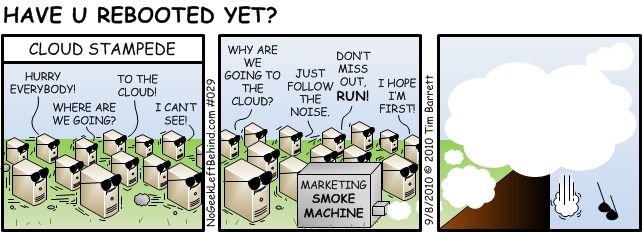
A friend of mine, Tim Barrett did this comic many years ago (image credit to NoGeekLeftBehind.com):

image

The comic definitely puts an image to the Cloud messaging and its results. :)

Let's continue to build our dreams doing what we love to do.

Have a fantastic day and thanks for reading!

Philip Elder
Microsoft High Availability MVP
MPECS Inc.
Co-Author: SBS 2008 Blueprint Book
Our Web Site
Our Cloud Service

Sunday, 1 September 2013

Exchange Server 2013: IE10 on Server 2012 and Windows 8 Crashes in /ECP Exchange admin center

In our greenfield deployments getting Exchange 2013 up and running around RTM time was a bit of a challenge give the reality that IE 10 on both Windows Server 2012 and Windows 8 just did not work.

To fix that problem the following needs to be installed:

Note that some security related settings may be reset once this update is installed.

A  prompt to set IE10 security settings is also to be had after the update was installed.

It is good to see that EAC can now be accessed as expected and without interruption.

Philip Elder
MPECS Inc.
Microsoft Small Business Specialists
Co-Author: SBS 2008 Blueprint Book

Chef de partie in the SMBKitchen
Find out more at
www.thirdtier.net/enterprise-solutions-for-small-business/

Windows Live Writer

Exchange 2013 ECP Error: The user has insufficient access rights. Active directory response: 00002098: SecErr: DSID-03150BC1, problem 4003 (INSUFF_ACCESS_RIGHTS), data 0

After setting up Exchange 2013 Standard on a VM we hit the following problem:

image

Server Error in '/owa' Application.

The user has insufficient access rights.

Description: An unhandled exception occurred during the execution of the current web request. Please review the stack trace for more information about the error and where it originated in the code.
Exception Details: System.DirectoryServices.Protocols.DirectoryOperationException: The user has insufficient access rights.
Source Error:

An unhandled exception was generated during the execution of the current web request. Information regarding the origin and location of the exception can be identified using the exception stack trace below.

Stack Trace:

[DirectoryOperationException: The user has insufficient access rights.]

System.DirectoryServices.Protocols.LdapConnection.ConstructResponse(Int32 messageId, LdapOperation operation, ResultAll resultType, TimeSpan requestTimeOut, Boolean exceptionOnTimeOut) +1904

System.DirectoryServices.Protocols.LdapConnection.SendRequest(DirectoryRequest request, TimeSpan requestTimeout) +381

Microsoft.Exchange.Data.Directory.PooledLdapConnection.SendRequest(DirectoryRequest request, LdapOperation ldapOperation, Nullable`1 clientSideSearchTimeout) +3849

Microsoft.Exchange.Data.Directory.ADDataSession.ExecuteModificationRequest(ADObject entry, DirectoryRequest request, ADObjectId originalId, Boolean emptyObjectSessionOnException, Boolean isSync) +1062

[ADOperationException: Active Directory operation failed on vW2012E.MPECSINC.local. This error is not retriable. Additional information: Insufficient access rights to perform the operation.

Active directory response: 00002098: SecErr: DSID-03150BC1, problem 4003 (INSUFF_ACCESS_RIGHTS), data 0

]

Microsoft.Exchange.Data.Directory.ADDataSession.AnalyzeDirectoryError(PooledLdapConnection connection, DirectoryRequest request, DirectoryException de, Int32 totalRetries, Int32 retriesOnServer) +3736

Microsoft.Exchange.Data.Directory.ADDataSession.ExecuteModificationRequest(ADObject entry, DirectoryRequest request, ADObjectId originalId, Boolean emptyObjectSessionOnException, Boolean isSync) +1945

Microsoft.Exchange.Data.Directory.ADDataSession.ExecuteModificationRequest(ADObject entry, DirectoryRequest request, ADObjectId originalId, Boolean emptyObjectSessionOnException) +27

Microsoft.Exchange.Data.Directory.ADDataSession.Save(ADObject instanceToSave, IEnumerable`1 properties, Boolean bypassValidation) +2082

Microsoft.Exchange.Data.Storage.ExchangePrincipal.Save() +1078

[StoragePermanentException: There was a problem accessing Active Directory. Check your network connections and try again.]

Microsoft.Exchange.Data.Storage.ExchangePrincipal.Save() +1600

Microsoft.Exchange.Clients.Owa2.Server.Core.RequestDispatcher.HandleLanguagePost(RequestContext requestContext, CultureInfo culture, String timeZoneKeyName, Boolean isOptimized, String destination) +2072

Microsoft.Exchange.Clients.Owa2.Server.Core.RequestDispatcher.DispatchIfLanguagePost(RequestContext requestContext) +642

Microsoft.Exchange.Clients.Owa2.Server.Core.RequestDispatcher.InternalDispatchRequest(RequestContext requestContext) +620

Microsoft.Exchange.Clients.Owa2.Server.Core.RequestDispatcher.DispatchRequest(RequestContext requestContext) +297

Microsoft.Exchange.Clients.Owa2.Server.Core.OwaRequestHandler.OnPostAuthorizeRequest(Object sender, EventArgs e) +352

System.Web.SyncEventExecutionStep.System.Web.HttpApplication.IExecutionStep.Execute() +80

System.Web.HttpApplication.ExecuteStep(IExecutionStep step, Boolean& completedSynchronously) +165

Version Information: Microsoft .NET Framework Version:4.0.30319; ASP.NET Version:4.0.30319.17929

There was not a lot that turned up in our searches.

In the end, we needed to run the following command on the Windows Server 2012 Essentials server from the Exchange 2013 install disk:

  • Setup /PrepareAD /IAcceptExchangeServerLicenseTerms
  • image

Once the above command finished running we hit refresh in IE and we were in.

image

Please note that these shots are via one of our labs we are running through in preparation for some SMB Kitchen Project content.

Philip Elder
MPECS Inc.
Microsoft Small Business Specialists
Co-Author: SBS 2008 Blueprint Book

Chef de partie in the SMBKitchen
Find out more at
www.thirdtier.net/enterprise-solutions-for-small-business/

Windows Live Writer

Wednesday, 28 August 2013

Some Thoughts on Microsoft in the SMB Space

If one approaches this post from an emotional level, that is built on all of the angst, struggles, and pain born of the Cloud drums out of Microsoft, that is their message but also the many products and services cancellations, over these last three or so years then it would not be hard to go down a very not-so-happy path.

So many bridges between Microsoft and us IT Solution Providers that work on the front lines of the SMB IT space (by our definition SMB is 1-75 seats or so) have been burned or even out-right blown up.

Many of us have struggled with the angst over where we were going to take our business and what kind of business model we would have two, five, and even ten years down the road. After all, we are in it for the long-haul right?

Why We Do IT

This post is more a reflection of the SMB IT Provider that is in the business out of passion for the products and services we get to work with. But, most especially for the joy it brings us to have a set of very happy clients on the other end of our IT practices.

That is our greatest reward. That is clients whose businesses are in the business to make money and do so as efficiently as possible on their IT because of what we do for them.

For us, the reality has come home to roost that Microsoft is much less a partner today than a competitor.

Yes, we are still building our solutions on the Microsoft stack and will continue to do so. Our solutions absolutely rock utilizing the products we do. We will continue building solutions that our competitors, like Microsoft and other large IT Solutions providers, could hardly hope to develop for their clients.

Why?

Because we as small business IT Solutions Providers live, breath, and work in the SMB Trenches. We understand small business in a way that a Gartner Survey or any other such knowledge peddlers could never hope to. This is because we _are_ a small business.

We small businesses are _not_ consumers, pro-sumers, or any other such "consumer" of goods and services.

We _produce_ products and services for others to consume. Or, we develop and sell products and services for other businesses to utilize in their _production_ of goods and services (Business to Business).

Microsoft's Value in SMB

So, what value do we see in Microsoft in today's SMB IT marketplace?

  • Products/Features
    • Hyper-V
      • Virtualization solutions have become affordable, both on VMware and Hyper-V, as a result of the competition between the two.
        • All one needs to do is watch VMware's stock and current restructuring efforts to see the impact Hyper-V has had on their margins.
      • Stack builds on a single box save our clients a lot on hardware, power consumption, cooling, and noise.
      • Clusters are very affordable for our clients when truly commodity based hardware (Intel Server Systems) are utilized over Tier 1.
    • Windows Server Essentials Experience Role
      • Finally, the Remote Web Access portal, RD Gateway, and other SBS-Like goodies can be dropped into a Windows Server Standard server setup.
    • Storage Spaces
      • Still new, but with lots of potential to impact how we do things for our clients with larger data sets.
    • Exchange
      • Despite the poor start to the product at what was probably Early Preview bits branded as RTM, Exchange Server 2013 is an awesome product with great potential for on-premises mail and BYOD management.
  • Partner Program
    • Loss of the Small Business Specialist program.
      • This is probably the "nail in the coffin" as far as the Cloud message to SMB IT Providers.
    • Competency Program structures drive us to expand or further distance ourselves from the Partner Program
      • Some of us are not comfortable with the idea of hiring on.
      • Plus, there are any number of other reasons for us to remain where we are at for now.
      • There are opportunities though. We just need the vision, time, and energy to pick them out and develop them.
    • Cloud, Cloud, Cloud, Cloud (Monty Python-esque theme here :) )
      • The drums are still beating.
      • The message is becoming all the clearer: Folks in SMB do not require any outside IT help. You can do it all yourself!
    • Cloud Essentials Program
      • Better get on board and start playing around with the freebie credit for Azure as this is one spot where we can develop some business opportunities.
  • TechNet
    • Now, keep in mind that folks that are Open Licensed will continue on with their TechNet subscriptions that are a Software Assurance benefit.
    • The loss of TechNet for lab use is most certainly of concern, but one has to wonder why it was terminated.
      • IMNSHO, we are at a point where the passionate SMB IT Provider, and Microsoft, have received yet another black eye due to the unscrupulous folks that abuse the system.

We are of the opinion that the current wave of Microsoft products, with the exception of Office 2013, are probably some of the best that we've seen in years.

Yes, mousers cried foul over the loss of the Start Button in Windows 8. But keyboarders never missed it. :) And yeah, there is a bit of a training struggle for folks to understand that there are two "rooms" if you will in Windows 8.

Microsoft "Partner"

With all of the changes that we've seen in Microsoft over these last two to three years we really have to wonder where they are going to be in two, three, or even five years.

Sadly the reality that the desktop PC is not really going to disappear in a business setting does not seem to phase anyone in stratosphere management at large corporations like Microsoft. :(

To top it all off, IMNSHO, the server is _not_ going to disappear in the SMB space.  Nor will the need for on-premises mail.

However, with the advent of so many failed/bad Microsoft product updates lately on so many products, some bringing down Hyper-V Failover Clusters, one really has to wonder how far off the vision has gone from providing a rock solid on-premises product experience from RTM to retirement?

Hopefully the bad patching situation that has been happening lately is only temporary and Microsoft moves some development back into actually testing those updates before deploying them to the world.

After all, being in business is about the products and services right? It's about providing the best possible value to the end-customer/client isn't it?

Can folks _really trust_ a company to provide a great Cloud experience when it seems like the on-premises products and services may be on their death-beds? Why develop patches and _test_ them if there is no will to keep the on-premises products alive?

And that begs this question: Can we SMB IT Solution Providers trust a company that has not come right out and said it, but has essentially drummed the message all the more clearly in these last 12-18 months that the "end is nigh" for the SMB IT Solution Provider? SMB belongs in the Cloud after all. Right?

Be straight with us. Be clear with us. If we knew where we truly stood as a "Partner" of Microsoft we would be better able to make decisions about where we are and where we need to go in the new era of competition _with_ Microsoft.

Trust is based on honesty between the parties. The messages out of Microsoft have been so mixed, and sometimes outright confusing, these last few years that one is never sure where we stand anymore.

Most certainly we need to be very aware, and wary, of what is happening both within the companies that produce the products we utilize and then within the product groups themselves.

Business Opportunities

On the flip-side the current state of SMB IT can provide an awesome opportunity for us to advance our on-premises and hybrid solution sets and skillsets. While it may seem daunting at first, we can indeed continue to build our SMB IT practice and triumph despite the naysayer's constant messages!

And, perhaps in the midst of all of this we could end up growing our businesses into that Microsoft Partner Competency holder that would get noticed and direct Partner support (note the absence of the quotes).

In the end, we may not reach those competency levels and/or even get noticed.

But, we can go home at the end of the day, maybe work a bit in the evening for our clients, knowing full well that there is a great group of folks, our clients, on the receiving end of our products and services that are very happy with us and what we do.

And that my friends is why, for the most part, we can sleep well at night eh? ;)

Well, maybe most nights. We are, after all, small business owners so the occasional sleepless night is a prerequisite! :D

Thanks for reading.

Philip Elder
MPECS Inc.
Microsoft Small Business Specialists
Co-Author: SBS 2008 Blueprint Book

Chef de partie in the SMBKitchen
Find out more at
www.thirdtier.net/enterprise-solutions-for-small-business/

Windows Live Writer

Wednesday, 14 August 2013

Microsoft Slaughtering It’s Own Cash Cow?

We in SMB IT have been hearing the Microsoft Cloud Drums for quite a few years now.

In the first year or two the call was along the lines of how great Microsoft’s new Cloud was to be and how we were all going to do well selling it.

Well, in SMB IT that pretty much fell flat on its face once it became apparent the SMB IT Provider was not be be billing the customer Microsoft was.

Plus, where was the SMB IT Provider supposed to fit in to the picture anyway?

The drums kept beating but the SMB IT Solution Provider did not listen.

Microsoft made some changes in their sales model for the Microsoft Cloud product line that allowed the SMB IT Provider to bill their clients, but uptake was probably very slow if at all.

Off to conferences and Webinars we go where “Partners” trumpet their great success selling Microsoft and other Cloud Vendor’s wares. How great their success was they were proclaiming but in the end we received a lot of fluff with little substance.

The drums are still beating today. However, they no longer beat for us to take up the call and sell Microsoft Cloud.

IMNSHO, they now beat the message to the end customer to avoid working with us altogether.

You don’t need the SMB IT Provider! You can do it all yourself! We’re making it really easy for you!

To be fair, Microsoft pushed really hard to get the SMB IT Provider on board with training and certification. They spent hundreds of thousands if not millions on getting us to on-board with the Small Business Specialist Community and the certification structures it required.

Those of us that took up to that beat, that is the SBSC and all it entailed, did really well and Microsoft took great pains to support us.

Unfortunately, in the end, the folks that drove Microsoft to create the SBSC and make efforts to bring things up to par kept on doing what they were doing: Giving Microsoft and other legitimate SMB IT Providers a black eye.

As much as the “Trusted Advisor” role has been poo poo’d by many behind the Cloud drum beating we are the ones that the SMB Business Owner will listen to over commercials, surveys, and Consumer Reports.

Yes, the ones responsible for the black eyes for both Microsoft and those SMB IT Providers doing the right thing will be the ones most hurt by their customers bailing away from the pain they’ve been in for however many years by adopting the Cloud over on-premises.

Why would those customers, that is the ones that have been repeatedly burned, trust us anyway? And why would they trust Microsoft to provide a Cloud service that say Google or Amazon may be able to do just as well if not better?

While we and our client population may not be in the majority as far as SMB IT, we do represent a substantial number of small to medium businesses and the directions they take with the IT infrastructure.

A sales driver within SMB is the excited Geek coming in with a new product that perfectly fits in to their client’s business model. In fact, the Geek would have a demo prepared that directly relates to _that specific client_ without even thinking about it.

That situation translates into sales. _Lots_ of sales. And business owners talk.

Perhaps I’m overestimating our worth here? Maybe I am but then again, maybe I am not.

The drums today are beating “You SMB Business go Cloud. Period.”

We are cautioning our clients that a hybrid approach may be a better rule of thumb for so many reasons. Think PRISM for one and the Patriot Act for another.

Now, given the Microsoft’s position for us is all-in for the Cloud one has to wonder how long it will be before Microsoft removes the “choice” in SME and Enterprise environments?

Meaning, how long before Microsoft makes on-premises a lot more expensive than their Cloud offerings to in effect remove that option?

Certainly the restructuring that has happened around a services model this new Microsoft fiscal year may indicate such.

Most certainly Microsoft is at a crossroads.

Depending on the tact they take over the next 12 to 24 months we could see a vastly different company down the road that may in fact be more like Apple was before it was bailed out or like RIM is today.

Drum beating the message and forcing us in SMB into a direction because as single units we are essentially powerless against them is one thing (though we’ve been seeing that we are not so powerless after all over this last year or so).

However, trying the same tact with SME and Enterprise businesses may well fall flat on its face.

No one person or business has ever liked being shoe-horned into an option.

If given no option by a vendor, then it is more likely that another will be found, or much to the possible surprise of Microsoft, and others before them, the business may carry on and/or build what is needed from within.

Most certainly changes are afoot and we need to be very aware of what is happening around us!

Philip Elder
MPECS Inc.
Microsoft Small Business Specialists
Co-Author: SBS 2008 Blueprint Book

Chef de partie in the SMBKitchen
Find out more at
www.thirdtier.net/enterprise-solutions-for-small-business/

Windows Live Writer

Friday, 2 August 2013

A Really Good Read on the State of IT and Cloud Outsourcing

It seems that Aidan Finn and I are somewhat on the same page as far as how the Cloud has been significantly strong due to the “Bad IT Pro”.

Indeed, if we in the SMB community especially had a majority of IT Pros that fit into the “Good IT Pro” category as defined by Aidan the Cloud would probably have little place in the small to medium business.

Now, have a listen to my interview podcast with Robert Crane of CIAOPS in Australia that was done in December of 2012:

Robert and I have a pretty good parlay around the Cloud versus on-premises situation in SMB IT with my touching on the need to be trained, keep up on the tech, and work hard at IT!

Ultimately, it is our responsibility to make sure our skill-set is up to the task of providing the best IT Solutions for our clients. This task costs in both time and money with the investment, yes it _is_ an investment to get trained, paying off in ways we sometimes are not able to anticipate!

Philip Elder
MPECS Inc.
Microsoft Small Business Specialists
Co-Author: SBS 2008 Blueprint Book

Chef de partie in the SMBKitchen
Find out more at
www.thirdtier.net/enterprise-solutions-for-small-business/

Windows Live Writer

Monday, 8 July 2013

Things are Cloudy: Some Monday Morning Cloud Reading and Thoughts on Trust

Here are a few interesting articles that paint some reality on the ongoing Cloud picture.

Both articles are a good read and provide some insight into company’s perspectives on being in the Cloud and Microsoft’s vision for the Cloud.

BTW, what exactly is meant by an “update” anyway? We are not too sure on that one.

Conflicting Messages for SMB IT

Now, the kicker that really brings about the meaning of the word “irony” is in this quote from the Business Week article.

The Office unit says packaged releases will still be available to users who are resistant to Office 365 and its frequent updates, but most of the team’s energy will be focused online. “Microsoft has an established history and trust with customers [emphasis ours],” says Pisoni. “So far those who are hesitant about going to the cloud, they’re willing to put their trust in Microsoft. No other competitor—Google, Box—has that established trust.” Raman Padmanabhan, chief information officer for Xerox’s (XRX) business services unit, has been briefed on Microsoft’s move to faster updates and says he supports the shift as long as the product is good. “It’s all about service and quality,” he says. “You have to have a certain quality or it just kills your business.”

How many of us in SMB have been banging our heads against the wall, so to speak, trying to make the message clear that in SMB IT it is the face-to-face time and relationship trust that we build up with our clients that are keys to both business’s success?

The business relationship and trust have always been, and will always be, the foundation to our way of doing business.

The Cloud Message and many of the Cloud Prophets have been trying to blow that off for SMB IT for the last three or four years now and yet here we have it straight from Microsoft. _Trust_ is the foundation for moving forward.

Yes, there is a little bit of frustration here and it may show so our apologies for that. :S

But, at least it is good to see in print that our own SMB IT way of doing things is confirmed, though not directly. :)

As time goes on we shall see how all things play out.

From this arm chair it looks like Microsoft is in the process of slaughtering their cash cows and diving in for the lowest common denominator ... which in the end means that they will be on the same, and level, playing field as the other Cloud Vendors.

IMNSHO, this is _not_ a good place for Microsoft to go.

Most especially because a huge chunk of the Microsoft Partner base, that is those of us IT Providers in SMB, is being stepped on to get to wherever Microsoft’s current Cloudy Vision is leading them.

Philip Elder
MPECS Inc.
Microsoft Small Business Specialists
Co-Author: SBS 2008 Blueprint Book

Chef de partie in the SMBKitchen
Find out more at
www.thirdtier.net/enterprise-solutions-for-small-business/

Windows Live Writer

Tuesday, 25 June 2013

SMBKitchen: Just Released: Hyper-V Cluster Configuration Considerations

This chapter, just released to the SMBKitchen Project’s knowledgebase, is jam packed with pearls that were the result of _months_ of trial and error plus sifting through all of the very incomplete and lacking vendor documentation.

image

Covered are all of the key elements required for setting up a Hyper-V Cluster on the Intel Modular Server with or without Direct Attached Storage via two SAS Controllers.

Also covered are the key elements required for setting up a cluster on a two or more node setup that utilize SAS based DAS intelligent storage. This configuration is the one we have been running with and is now our main focus as the Intel Modular Server has been retired.

image

This document covers a lot of different areas including node configuration, storage, networking, and more.

Cluster for highly available virtual machines, and now that we have the 2012 R2 bits, for Storage Spaces are an important part of our SMB business strategy going forward into the On-Premises and Hybrid future.

Coming soon for the SMBKitchen project will be a series of How-To videos on everything from teaming in Windows Server 2012 via PowerShell to configuring RemoteFX. There are plans to do cluster How-To videos as well.

Tie that into the author’s chats we have once a month that give subscribers front-line access to the authors and I am sure that we are providing great value for the subscription dollars! :)

Philip Elder
MPECS Inc.
Microsoft Small Business Specialists
Co-Author: SBS 2008 Blueprint Book

Chef de partie in the SMBKitchen
Find out more at
www.thirdtier.net/enterprise-solutions-for-small-business/

Windows Live Writer

Tuesday, 11 June 2013

Looking Cloudy: PRISM Reading

As things move along PRISM is making great waves throughout our industry.

Susan Bradley linked through to another awesome article on PRISM penned by Erica Absetz (eabsetz).

Erica does an excellent job of summarizing some critical aspects of PRISM with some valuable questions about how the program actually works.

Her article also contains a number of links to further articles discussing the PRISM program.

From her article:

Both Facebook and Google denied any previous knowledge of the PRISM surveillance program after concerns they may have been part of the program. Many other technology companies thought be be part of PRISM issued similar statements saying that they did not allow the government “direct access” to their systems. However, the NY Times reports that Google, Microsoft, Apple, Facebook, Yahoo, AOL, and Paltalk all negotiated with the government and were required to share information due to the Foreign Intelligence Surveillance Act (FISA). The Guardian also states that Microsoft has been a part of this information sharing program since the beginning in December of 2007 and was joined by Yahoo in 2008, Google, Facebook and PalTalk in 2009, YouTube in 2010, Skype and AOL in 2011, and Apple in 2012. At this point, it is a game of "who do you trust?" The government who finds such data incredibly valuable, or the corporations that sometimes rely on such data for their business model (e.g. Facebook). [emphasis ours]

Indeed, who can we trust?

As far as we are concerned the two words “Internet” and “Privacy” do not belong anywhere near each other.

Our Rule of Thumb: Want something to be private? Never publish it a public network like the Internet or cell network in any way shape or form. No e-mail, no picture texting, no SkyDrive, and so on. None. Nadda. Zippo. Zilch.

We here have been of the opinion that there is no sacred data sanctuary anywhere on the Internet.

Remember this?

    • Former AT&T technician Mark Klein is the key witness in the Electronic Frontier Foundation's class-action lawsuit against the telecommunications company, which alleges that AT&T cooperated in an illegal National Security Agency domestic surveillance program.

So, while PRISM is bringing to light the fact that government agencies are spying on the general population today, we seem to have very limited memories since the timelines on the above article go back to 2004!

Like any news, it is up to us to keep that squeaky wheel consistently squeaky to the _general population_ or like any other news item, and perhaps hoped for by the corporations and powers-that-be, PRISM and its implications will slowly wink out of our mind’s eye until the next “big story” breaks.

Philip Elder
MPECS Inc.
Microsoft Small Business Specialists
Co-Author: SBS 2008 Blueprint Book

Chef de partie in the SMBKitchen
Find out more at
www.thirdtier.net/enterprise-solutions-for-small-business/

Windows Live Writer

Monday, 10 June 2013

Monday Morning Monitor Cloth Reading: PRISM and it’s Cloud Implications

Yeah, the coffee may end up out there and not because we have a great moment to laugh about.

Most of us have seen bits and pieces of the news about the United States Government’s program called PRISM.

This article on Computer World is an excellent read on PRISM and the big Cloud vendor’s statements that they were oblivious.

Jonny Evans is bang on with his assessment on the big Cloud vendor’s denials place them in a very awkward position. Perhaps a better response would have been to wait things out a bit and then come clean with customers about government’s access to customer data.

We’ve all known about the possibility of governments accessing data with Cloud vendors being able to remain silent with their customers about that access.

The news about PRISM puts this reality in our faces and gives everyone a moment to have Cause for Pause.

For flat file data storage this situation presents an excellent opportunity for vendors of flat file encryption services that work on that data before it gets pushed up to the Cloud.

However, for things like hosted e-mail where raw content is sitting on the Cloud Vendor’s systems we know of no way to protect that data at all short of keeping in on-premises.

EDIT 2013-06-10: My fellow SMBKitchen author Susan Bradley has called me on my exclusion of the possibility of encrypted data hosted in Cloud based Exchange servers.

I do apologise for missing the fact that there _are_ vendors out there that can do just that.

CipherCloud is one such vendor that Susan mentioned.

So, off to their site we go and start a chat session to find out how much this service would cost us:

image

Holy Sugar Smacks!

Okay, so there are vendors out there that do this but at this time they are not very SMB friendly. :)

Philip Elder
MPECS Inc.
Microsoft Small Business Specialists
Co-Author: SBS 2008 Blueprint Book

Chef de partie in the SMBKitchen
Find out more at
www.thirdtier.net/enterprise-solutions-for-small-business/

Windows Live Writer

Wednesday, 29 May 2013

Windows Azure – Client OS Policy Update and SMB IT

We have a lot going for us in the Hybrid Cloud/On-Premises solution set as we grow our product knowledge and develop solutions to blend the best of both worlds.

However, this is one announcement that really hits home for us in SMB:

image

There’s no guarantee that the above link will be functional at a later date so:

Dear Customer,

We recently published an updated support life cycle policy for Windows Azure Cloud Services for web and worker roles. This email outlines these new policies and the associated timelines for migration:

Guest OS 1.x deprecation (retirement deadline: June 1, 2014).

60 days auto-upgrade policy for Cloud Services using manual OS upgrade option for Guest OS version.

Retirement of Windows Azure SDK for Cloud Services versions 1.0, 1.1, 1.2, 1.3, 1.4, 1.5 effective June 1st 2014.

Changes to Guest OS families
The Guest OS 1.x family based on the Windows Server 2008 operating system is being retired. We are providing 12 months advance notice to you. The official retirement date for the Guest OS 1.x family is June 1, 2014. After that date, you’ll no longer be able to deploy new web and worker roles with family 1.x deployments, and your existing family 1.x deployments will be automatically moved to a supported Guest OS family.
Please plan to transition your Cloud Services deployments that use the Guest OS 1.x family to the following supported Guest OS families:

• Guest OS family 2.x (based on Windows Server 2008 R2)

• Guest OS family 3.x (based on Windows Server 2012—recommended)

Customers who are using the Guest OS 1.x family don’t need to redeploy their Cloud Services because an in-place upgrade from version 1.x to 3.x is supported in the Windows Azure SDK 2.0. If you don’t upgrade by the June 1, 2014, deadline, you’ll automatically be upgraded to a supported Guest OS family.
Changes to Guest OS version
On June 1, 2013, the new Guest OS Version support policy becomes effective. Starting June 1, you have 60 days to upgrade your Cloud Services deployments to the current or prior Guest OS version in each supported Guest OS family.
As soon as possible, please start the transition of your Cloud Services deployments to one of the following supported Guest OS versions:

• Guest OS family 2.x supported releases: 2.13 (Release 201210-01) and 2.14 (Release 201302-03)

• Guest OS family 3.x supported releases: 3.1 (Release 201210-01) and 3.2 (Release 201302-03—automatic upgrade is recommended)

The official retirement date for all previous Guest OS versions is August 1, 2013. Any Guest OS deployment that’s not running one of these supported Guest OS versions at that time will be automatically upgraded to the current Guest OS version.
Changes to Windows Azure SDK for Cloud Services
We’re also announcing the retirement of the Windows Azure SDK versions 1.0, 1.1, 1.2, 1.3, 1.4, and 1.5. The official retirement date for the above SDKs will be June 1, 2014. After that date, you’ll no longer be able to use these SDKs to author and deploy new Cloud Services (web and worker roles). Further, Customer’s Cloud Services authored & deployed using deprecated Windows Azure SDK will not be covered under Windows Azure Cloud Services SLA. Customer’s Cloud Service will not be covered under support contract as well.
Notifications
The OS and SDK retirement dates will be communicated to customers through an MSDN or RSS feed:
MSDN: Windows Azure Guest OS Releases and SDK Compatibility Matrix

RSS feed

To get more details, refer to the support life cycle policy.
Thank you,
Windows Azure Team

We run a lot of legacy applications at client sites. Accountants and lawyers have applications that just don’t play nice with more modern 64-bit operating systems.

What does the Azure Team mean by “in-place” upgrade anyway? As in upgrade that production VM operating system from Server 2008 to Server 2008 R2 or 2012 RTM via in-place?

We are most certainly not sure what is meant by this but we stopped in-place upgrades in the NT 4.0 and Server 2000 era for a reason.

We have an advantage, at least at this point until software vendors force everyone into their Cloud services, in that we can customize our IT Solutions for the client’s environment.

In this case, Windows Azure has a limitation in the solution set flexibility that we can provide. Plus, the situation with the drop of one OS means that the client would probably be forced into some sort of cost/support scenario for their Windows Azure hosted environments.

In a positive economic situation this may not be too much of a hurdle for an SMB to overcome.

However, if the economies of the world sour even further that monthly nut for Cloud services may put a real damper on the business’s ongoing monthly cash flow.

On-premises offers the SMB the assurance that their business can keep operating, even after pulling the MSP plug (hopefully they _own_ the licensing and equipment), for a year or two when things are tight.

And, that on-premises solution set can be paid for while the cash is there. :)

And, BTW, note how Windows Azure gets around the actual “Windows Server” product life cycle by creating their own Azure version 1, 2, 3, etc?


image

Philip Elder
MPECS Inc.
Microsoft Small Business Specialists
Co-Author: SBS 2008 Blueprint Book

Chef de partie in the SMBKitchen
Find out more at
www.thirdtier.net/enterprise-solutions-for-small-business/

Windows Live Writer

Tuesday, 12 February 2013

Small Accounting Firm: Microsoft Stack Licensing and Solution Costs Example

Up here in Canada the incumbent cell providers have it pretty good. When travelling to the US we can obtain a RoamMobility plan for pennies on the dollar versus our Canadian provider’s rates.

The average small firm pays between $80 and $110 per month for each cell phone they provide to their users. This includes talk, text messaging (text, picture, and video), and the requisite 1GB to 3GB per month of bandwidth.

If we take the mid-range for this example we can say the average firm spends $90/Month so for a ten seat firm the cost is $10,800 user per year.

Now, let’s look at what the cost of a stack based solution is for the software licensing (New Open Value Agreement with the 3 Year Spread Payment option).

  • Base Server: OS for DC and WSUS+LoBs (2 VMs)
    • R18-01855 Server CAL $27 ($1270/Year)
    • 6VC-00701 RDS CAL $77 ($770/Year)
    • P73-05599 Server STD $750
      • DC + RDS/WSUS/LoBs base solution with 2 VMs stop here.
    • Solution cost: $2,790/Year
      • $23.25/User/Month
  • Add Exchange into the mix: Exchange + RDS Role moved here (2 VMs)
    • 312-03037 Exchange Standard: $439
    • 381-02257 Exchange CAL $49 ($245/Year)
    • P73-05599 Server STD $750
    • Solution cost: $1,434/Year
      • $11.95/User/Month
  • Total cost: $4,224 (Works out to $35.20/Month/User – More than half a cell contract cost)

A small single socket E5-2400 series server with 64GB ECC, Hardware RAID + flash cache, 8x 600GB 10K SAS in RAID 6 would be about $4,500.

We amortize the cost of the server over 36 months as that is our expectation for its service life.

  • Server Cost: $4,500
    • 10 Users = $12.50/Month/User amortized over 36 months.

So, our IT Solution total cost per user is now $47.70/Month.

That’s about half our cell contract cost per month per user.

The labour costs and ongoing maintenance costs would be the next thing to discuss with our prospective client. Suffice it to say that the labour and support portion would place the monthly cost per user into the $30 to $70 per month range depending on the services we provide.

Costs, benefits, and drawbacks would certainly be a part of this conversation.

  • Are there any concerns about data ownership?
  • Are there compliance regulations that need to be followed?
  • Would there be a need to grandfather communications data for legal access at a later date?
    • Note that for an accounting or law firm this situation could arise years down the road.
  • What are the risks versus benefits for an on-premises solution versus a Cloud solution?

In the end the firm gets the best solution for their IT budget and it will work with their proprietary accounting applications and/or other Line of Business applications that can be quite finicky to work with.

Plus, they can be assured that the IT Solution will more than meet their expectations for up-time and performance for its entire service life.

Remember, when it comes to the conversation we need to have with our clients or prospective clients we need to focus on the cost per month per user. Yes, there will be some sticker shock involved, there always is, but once the numbers have been put into perspective relative to the per month cost folks can begin to see the value in what they are receiving.

Philip Elder
MPECS Inc.
Microsoft Small Business Specialists
Co-Author: SBS 2008 Blueprint Book

Chef de partie in the SMBKitchen
Find out more at
www.thirdtier.net/enterprise-solutions-for-small-business/

Windows Live Writer

Friday, 26 October 2012

Installing Microsoft Exchange 2013: Unified Communications Managed API 4.0 Runtime Not Found

During our test run at installing Microsoft Exchange 2013 Standard on our newly minted Windows Server 2012 Essentials domain we hit a weird error that turned out to be a PEBKAC (me) issue.

When one does a search for Exchange 2013 Prerequisites a number of different sites come up that deal with installing Exchange 2013. However, most, if not all have Exchange 2013 Preview and or Preview components linked in their posts.

image

The above snip is from the Microsoft Download site. Note the top one. Most of the blog posts link to the (Preview) download! :P

image

So, about half an hour after exercising our ability to discover the definition of insanity (doing the same thing over and over all the while expecting a different result) We discovered that the download was different via a Microsoft link (not sure which one).

Another clue that should have rattled the brain cells at this late hour in the day was not the following:

image

It was actually the fact that all of the Unified Communications Managed API 4.0 Runtime (Preview) was in that list!

Oh, and by the way, the Exchange 2013 setup routine will do the necessary AD preparation:

image

So, please make sure to have a System State Backup in place before running the Exchange 2013 Setup Routine!

Philip Elder
MPECS Inc.
Microsoft Small Business Specialists
Co-Author: SBS 2008 Blueprint Book

Windows Live Writer

Wednesday, 8 August 2012

MPECS Inc.'s Entry Level, Mid-Level, and Premium Level IT Solution Sets

We have a number of IT Solution sets in our repertoire.

Here are three IT Solutions we have posted on our blog to give you an idea of where we can start through to a high end Hyper-V Failover Cluster based on the Intel Modular Server.

With today's Intel Server Systems, the Intel Modular Server, Promise Storage, and IBM Storage we can provide some highly customized IT Solutions for our clients and prospective clients.

For those that request on-site warranties from Tier 1 we would offer IBM Servers and their warranties.

With the advent of Windows Server 2012 and the awesome new Hyper-V features we can go even further with companies that have multiple sites using Hyper-V Replica as well as the now accessible DirectAccess feature that is in Windows Server 2012.

The On-Premises future looks very bright indeed! :)

Philip Elder
MPECS Inc.
Microsoft Small Business Specialists
Co-Author: SBS 2008 Blueprint Book

*Our original iMac was stolen (previous blog post). We now have a new MacBook Pro courtesy of Vlad Mazek, owner of OWN.

Windows Live Writer

Tuesday, 31 July 2012

SMB Solution Sets Going Forward

This is a tweak of a post on Spiceworks - SBS End of Life.

***

SBS meets a specific market and did so quite well. As Tyler has mentioned it was relatively straightforward to get up and running and when done correctly ran for years requiring basic SBS specific maintenance.

Yes, we have lost the SBS pricing. But, as far as we can tell at this point the increase to the small business to have AD and Exchange in-house will only be marginally more. For those requiring SQL the step up will be a lot more.

The other side of that coin is that SBS brought together, IMNSHO, probably one of the strongest communities to back not only SBS but a whole host of SMB oriented products under one umbrella.

While the loss of SBS may seem like a huge shock for many, in the end it is only change and change is something we should all be used to working in the IT industry.

The cost comparisons between on-premises and Cloud based solutions are only now beginning in the SMB arena. As Cloud matures we will begin to see the real costs associated with Cloud based solutions versus their on-premises siblings and thus provide our clients with a well researched solution set that they can choose from.

Going forward we will have something in SMB that SBS did not provide us: Flexibility.

We can now design a full Microsoft solution stack based solution and CAL it up using the Core CAL Suite or even the Enterprise CAL Suite with the option to run with individual product CALs if the client so chooses.

There are a lot of awesome new products coming down the pipe that will be attractive to SMB that SBS did not give us.

  • Lync is definitely one of them.
  • Built-in Clustering technology now freely available in Windows Server 2012 STANDARD makes for some very lucrative highly available options that SMB may not have had before.
  • DirectAccess is another feature that SMB will find it difficult to be without _once they have it_!
    • Search will always be the on-premises Killer-App that Cloud cannot provide across diverse platforms.

We are on the edge of a truly amazing time.

The on-premises solution set is growing in ways we could only have dreamed of when SBS 2003 was released almost 10 years ago!

Tie that into the many Cloud based products that are mature and backed by geo-redundant and privacy respecting vendors and we have an out-of-the-park home run.

My .25 (2bits) for today. :)

Philip Elder
MPECS Inc.
Microsoft Small Business Specialists
Co-Author: SBS 2008 Blueprint Book

*Our original iMac was stolen (previous blog post). We now have a new MacBook Pro courtesy of Vlad Mazek, owner of OWN.

Windows Live Writer

Monday, 30 July 2012

One Little Feature Where In-House/On-Premises Kills Cloud

This is a tweaked post that was made to the Yahoo SBS2K forum.

***

This is how in-house based Search works when set up properly:

  • Server side:
    • Windows Server 2008 RTM/R2+ hosts files.
    • Win2K8 RTM/R2 set up with Search and indexes file shares.
  • Client side (Win7+):
    • Library created and called whatever (we use SharedFolders)
    • Shared Folders on above server(s) added to library.
      • Use Index Options to add additional folders.
    • Outlook 2010 set up and updated on client.
    • Can add as many mailboxes as allowed by admin.
  • Search process:
    • Click START
    • Type "Cloud or not - comparison ... " (SBS2K topic for this post)
      • As an example, this thread would start showing up in the results for e-mail hosted in Outlook.
      • Now, if we were also shipping Excel/Word/PP/Publisher files back and forth those would show up in the search results under FOLDERS.

And now the clincher?

  • Type "Philip" in the search field and the following results:
    • Any e-mail to/from name
    • Any contacts with that name.
    • Any Word/Excel/PP/Publisher file title with name
    • _ANY_ Word/Excel/PP/Publisher file with name IN it

That's the biggest advantage an in-house solution has over Cloud. Period.

Search is the one killer-app that saves users gobs of time in a year. That translates to a lot of $$$ for the company in efficiencies gained.

As a result, our in-house/on-premises solutions become a lot more attractive. :)

IMNSHO, working remotely via RemoteApp or OWA feels wrong. I can't search for things as quick as I can when working from a connected desktop. If there is a need to search one needs to jump between OWA and SharePoint Online in order to find it. That is a huge drawback.

Now, with Server 2012 we get DirectAccess. Guess what?

SEARCH ANYWHERE!

In-house just took a _giant_ leap forward. :D

Philip Elder
MPECS Inc.
Microsoft Small Business Specialists
Co-Author: SBS 2008 Blueprint Book

*Our original iMac was stolen (previous blog post). We now have a new MacBook Pro courtesy of Vlad Mazek, owner of OWN.

Windows Live Writer